



Imagine a potential customer searching for exactly the service your company offers. They type in their query and, within seconds, receive a comprehensive answer generated by Artificial Intelligence. The information is accurate, answers their question and allows them to move forward. But your company does not appear among the sources.
Not necessarily because your website ranks poorly or because you do not have quality content. The problem could be something else: that content does not respond well enough to what the user needs or does not give Google enough reason to consider it a relevant source.
With Google’s evolution towards AI Overviews and AI Mode, the challenge for B2B companies is no longer simply to achieve a strong position in traditional search results. They also need to work towards being present in the answers AI builds from different sources.
And that is changing the way we think about SEO.
From keywords to answers
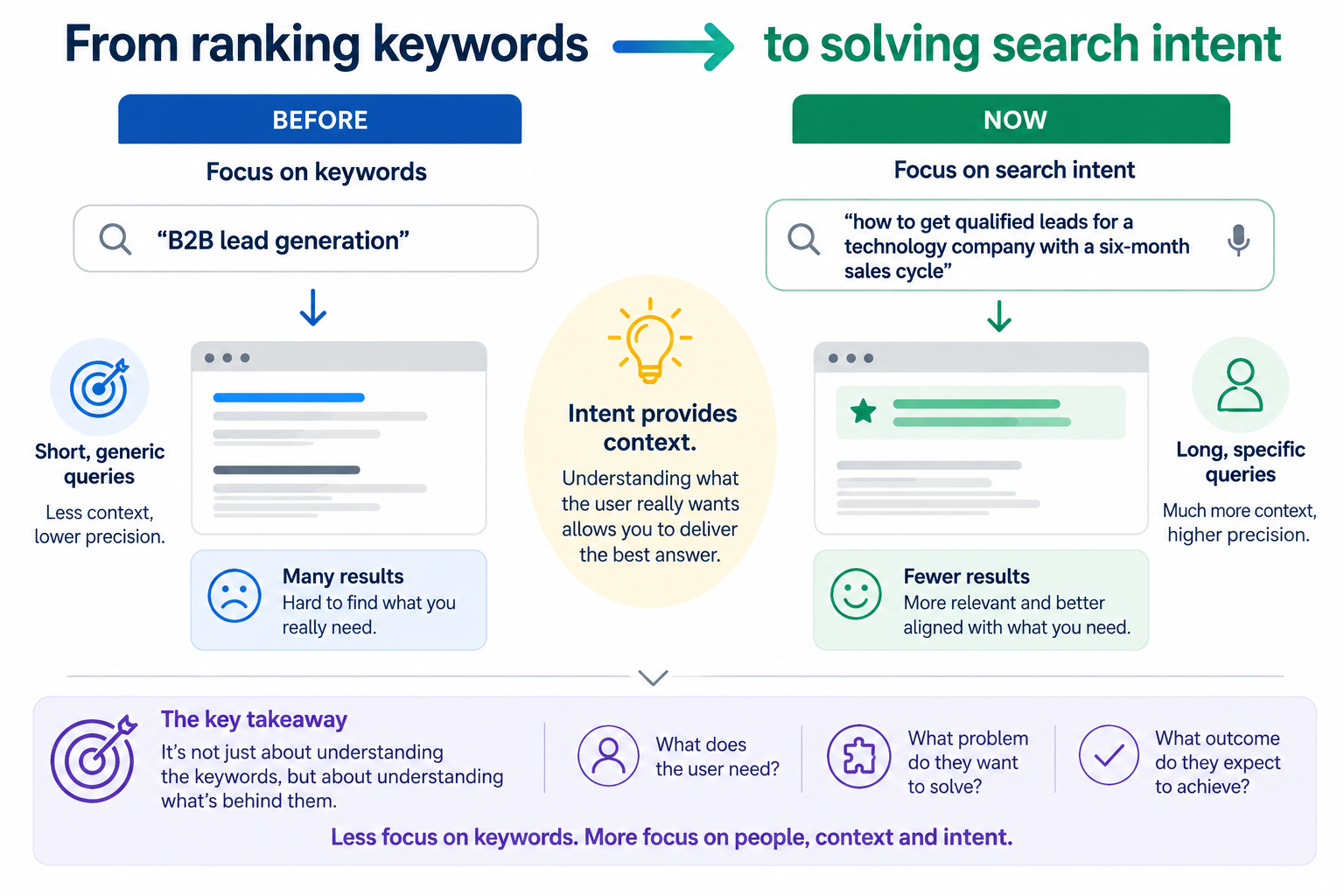
For years, a large part of an SEO strategy began by identifying the keywords users were searching for and creating content around them. That work still makes sense. But focusing solely on keywords is no longer enough.
AI-powered search features can analyse different sources, connect information and build an answer tailored to a specific query. Google also uses techniques such as query fan-out, which allow a question to be broken down into multiple related searches in order to gather more comprehensive information.
The four pillars of SEO in the AI era
1. Demonstrate genuine authority and experience
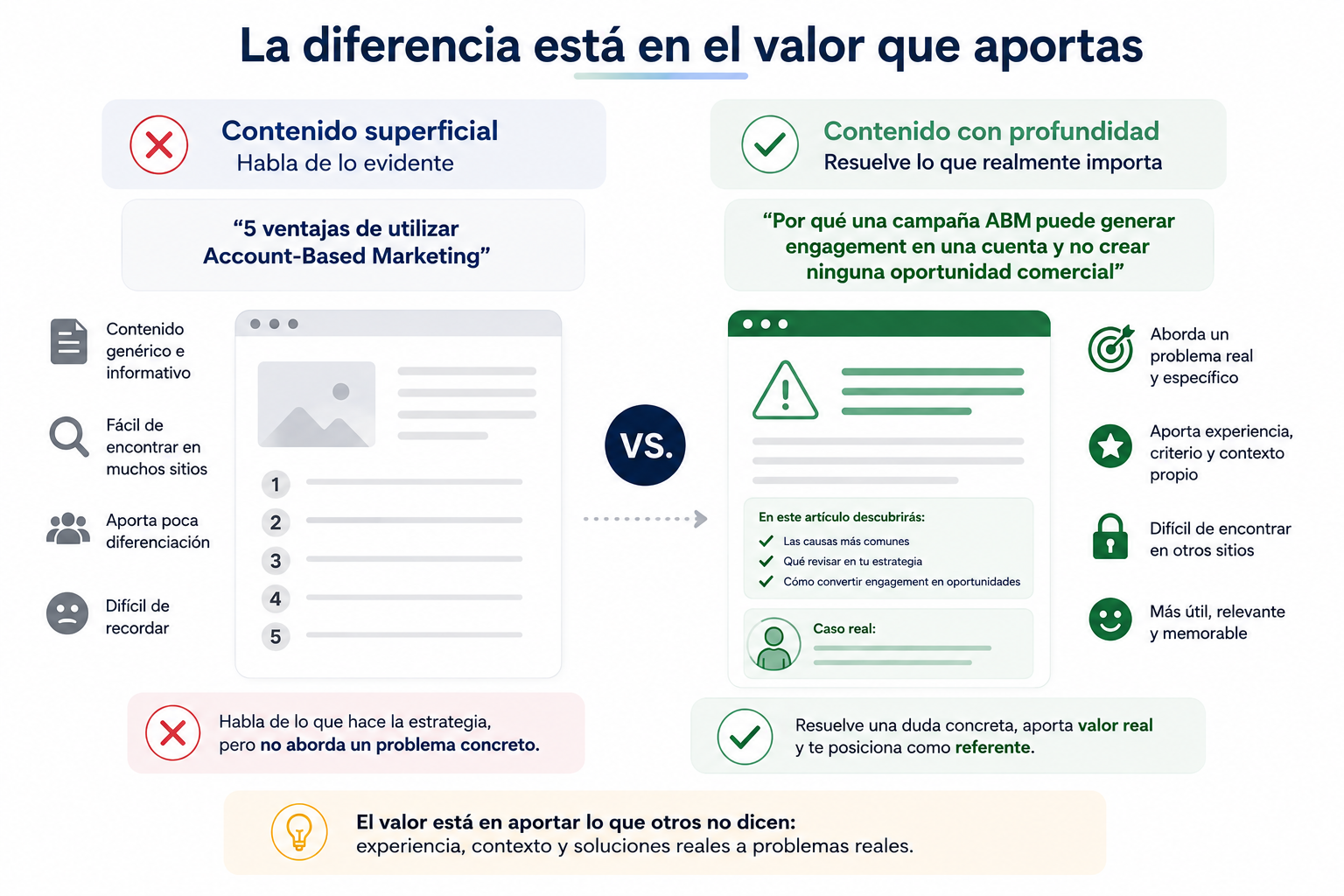
The internet is full of content explaining practically the same things. And the mass generation of AI-written content is increasing that volume even further. The key to differentiation is demonstrating that there is genuine knowledge behind the content.
| Google uses the concept of E-E-A-T — Experience, Expertise, Authoritativeness and Trustworthiness — as a framework for assessing content quality. It is not an individual ranking factor, but it provides a very good indication of the direction a content strategy should take. |
|---|
Identify who writes your content and what experience they have. Use official sources and verified data. Include case studies, lessons learned from clients, your own research or situations your team has encountered in real-world projects.
A technology company that has spent years working with distribution channels, for example, has something that AI cannot generate on its own: accumulated experience of what works, what fails and why.
2. Structure content to make it easier to understand
A good article should not be an endless block of text. Information needs to be easy to interpret both for people and for search engines.
Use a clear H2 and H3 hierarchy, introduce the main answer at the beginning of each section and use tables, lists or graphics when they genuinely help explain the information.
Structured data or Schema Markup also remains useful for providing Google with explicit information about certain elements of a page.
But there is an important distinction: there is no special Schema for appearing in AI Overviews or AI Mode. Google states that no specific markup is required for its AI features.
The foundations remain the same: a technically accessible, properly indexed website with well-organised content.
3. Write with the way your customers ask questions in mind
People do not always search in the same way a keyword appears in an SEO tool. They search the way they speak and, above all, the way they think when they have a problem.
- “Why aren’t my leads moving from MQL to SQL?”
- “Which channel works best for reaching IT decision-makers?”
- “Does ABM make sense if my company works with a small number of strategic accounts?”
- “How can I tell whether a demand generation campaign is working?”
These queries are much closer to a real conversation and contain very clear intent. That is why, before creating content, it is worth asking what our potential customer really wants to know and what they will need to know next.
A good practice is to provide a brief answer at the beginning and use the rest of the section to add context, examples and supporting arguments.
Frequently asked questions can also be useful when they address genuine user queries. Not because there is a formula that guarantees inclusion in an AI-generated answer, but because they help clearly address different needs related to the same search.
4. Provide information that cannot be found on every other website
This is probably the most important point.
Try a simple exercise before publishing an article: search for the topic on Google and review the top results. If your content says exactly the same thing, follows a similar structure and uses similar examples, what are you really adding?
The answer should not be “we have used different words”.
Google recommends creating useful, original content based on first-hand knowledge or experience, rather than producing pages whose sole purpose is to target specific queries.
You can include campaign results, lessons learned from projects, your own benchmarks, comparisons, original graphics, internal methodologies or common mistakes your team regularly identifies.
The key is to move away from repeating what everyone already knows and towards solving specific problems with your own experience and judgement.
Technical SEO still matters
Talking about AI can make it seem as though everything now depends on content. It does not.
For Google to consider a page for its search features, it first needs to be able to find, crawl and index it correctly.
Website architecture, internal linking, speed, mobile optimisation, accessible text content and the correct implementation of structured data all remain part of a solid SEO strategy.
It is also worth paying attention to images, videos, graphics and other original resources. A good diagram can explain a process better than four paragraphs and, at the same time, enrich the context of a page.
The priority should not be to add elements because “AI likes them”, but to ensure that each page is easier to understand and more useful for the person who visits it.
Don’t measure rankings and traffic alone
The evolution of search also requires us to rethink how we measure results. Organic rankings and visits remain relevant, but in a B2B environment there are more important questions.
Who is reaching our website? Which content generates high-quality interactions? Which pages contribute before a conversion? Are we gaining visibility around the topics we want the market to associate us with?
Because attracting 10,000 visits from people who will never become customers may contribute less to the business than attracting 500 people from the right companies and profiles.
The goal of SEO should not be to generate traffic for the sake of traffic, but to turn visibility into an opportunity to start commercial relationships.
SEO isn’t disappearing: it is evolving with the way people search
AI Overviews and AI Mode are changing how people find and consume information, but they are not replacing the foundations of SEO.
In fact, they reinforce some of them.
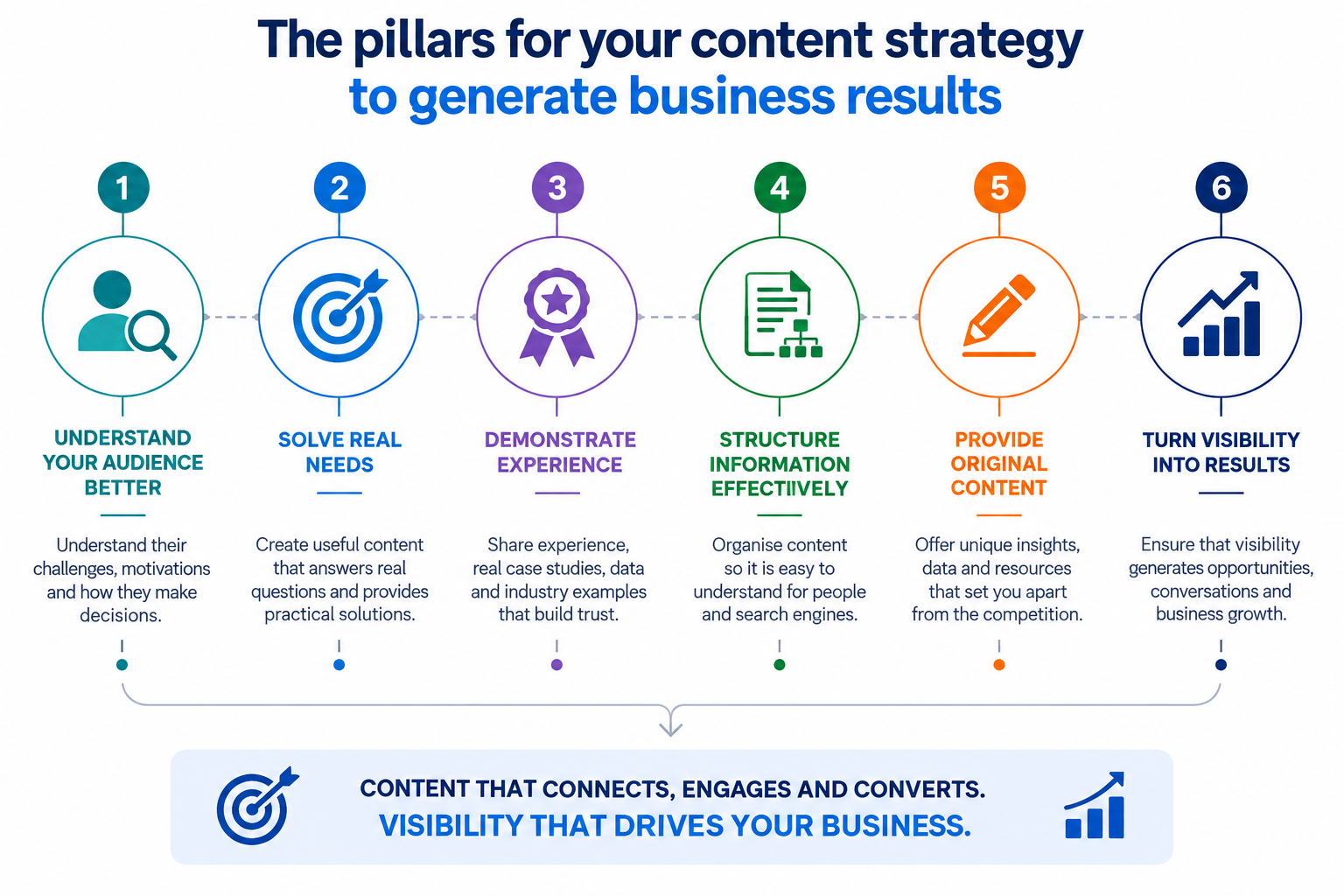
The difference is that it is no longer enough to ask what we want to rank for. We need to ask why Google — and, above all, our potential customer — should choose our content over everyone else’s.
At PGR, we help B2B technology companies develop digital marketing strategies that connect SEO, content, data and conversion to turn visibility into genuine business opportunities.
If you want to find out how well prepared your website is for the new era of AI-powered search, get in touch with our team and we’ll analyse your strategy.

