Most technology companies have been investing in organic search visibility for years. They have optimised websites, worked on keywords, developed content strategies and built authority to appear among the top results on Google.
However, more and more IT managers, technology directors and business decision-makers are no longer starting their searches on a traditional search engine. They are asking ChatGPT, Gemini, Perplexity or Copilot directly.
And this is where a problem arises that many companies have yet to identify.
When a potential customer asks what the best cybersecurity solution for an SME is, how to automate onboarding processes or which network management platform is best suited to their environment, AI tools do not display a list of links. They generate a direct answer and select the sources they consider most reliable to build it.
If your company does not appear in that answer, for that user it practically does not exist.
This is not just another technological shift. It is a change in the way people discover suppliers, compare solutions and make purchasing decisions.
Just a few years ago, the main objective was to generate clicks from Google. Today, the challenge is different: getting artificial intelligence systems to recognise your content as a reliable source and incorporate it into their answers.
This new landscape has given rise to Generative Engine Optimisation (GEO), a strategic evolution of traditional SEO aimed at ensuring that companies are understood, referenced and cited by generative engines.
For IT companies, the impact is particularly significant. Sales cycles are long, solutions are complex and trust plays a decisive role in every sales opportunity. When an AI system cites a source, it directly influences how a potential customer perceives a brand.
That is why the question is no longer whether your company appears on the first page of Google.
The much more important question is: Does your company appear in the answers your potential customers receive when they ask AI?
What exactly is GEO and how does it differ from SEO?
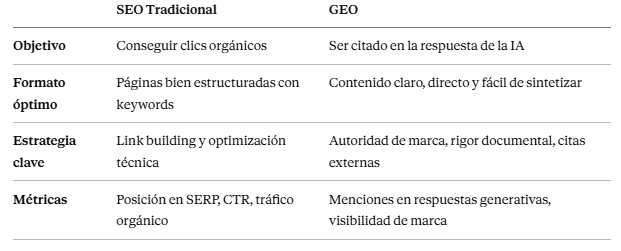
Traditional SEO aimed to drive clicks to your website. GEO seeks something different: for AI to synthesise your content and include it in its answer, whether or not the user visits your website.
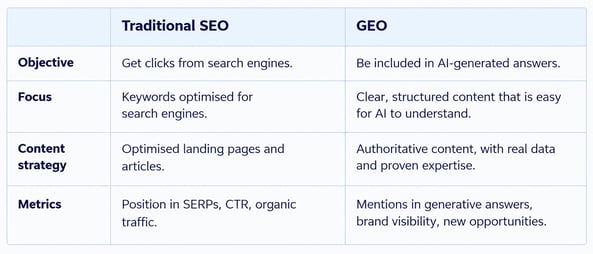
The reality is that both disciplines need to coexist. Content optimised for GEO also tends to improve many factors that are relevant to SEO.
GEO: an opportunity for B2B technology companies
IT companies typically work with complex products, long sales cycles and decision-making processes where trust plays a fundamental role.
That is precisely why GEO represents a strategic opportunity.
Companies that succeed in becoming trusted sources for generative engines do not just increase their visibility. They also strengthen their positioning as industry authorities and create a competitive advantage that is difficult to replicate.
The question is no longer simply how to appear on Google.
The question is whether your company is part of the answers provided by artificial intelligence systems when your potential customers are looking for solutions.
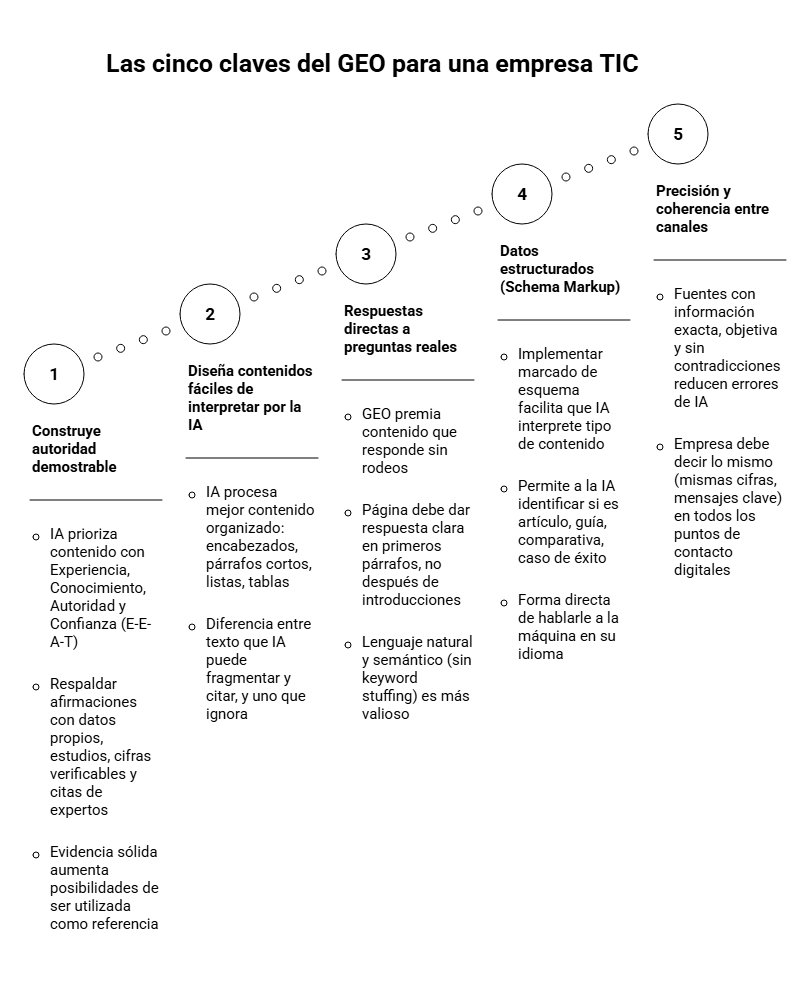
The five keys to GEO for an IT company
Generative models do not select sources at random. They use signals of trust, relevance and quality to decide which information to incorporate into their answers.
An example applied to the IT sector
Imagine two companies specialising in cybersecurity.
The first publishes a services page with generic messages about digital protection and technological transformation.
The second develops a content library explaining how to implement Zero Trust models, analysing regulatory trends, sharing use cases and providing data from real projects.
When an AI system receives a query related to enterprise cybersecurity strategies, it is far more likely to use information from the second company.
Not because it has more keywords, but because it provides more context, greater authority and more useful expertise.
How PGR approaches content strategy for GEO
At PGR, we help IT companies build content architectures that work for both traditional SEO and new generative engines. This includes:
-Auditing existing content to identify which pieces have the potential to be cited by AI and which need to be reworked.
-Redesigning the editorial structure: information hierarchy, direct-answer formats, and the inclusion of proprietary and industry data.
-Implementing Schema Markup and metadata optimised for generative engines.
-Authority strategy: identifying media outlets, publications and forums where external mentions can be secured to strengthen your brand’s credibility with algorithms.
The time to act is now
The adoption of generative search engines is growing at a pace few expected. Companies that adapt their content now will have a significant advantage over those that wait until it becomes an “established trend”.
Want to know how to position your IT company in answers from ChatGPT, Gemini or Perplexity? Talk to the PGR team and we’ll assess your current situation together.