



You may have an excellent solution, a website that ranks well and a content strategy already in place. Yet the opportunities still aren’t coming in as you expected. The problem usually isn’t what you offer or how you explain it. It’s that your potential customers aren’t yet looking for anything like your solution.
This often happens in B2B, particularly when you offer specialist services, innovative propositions or solutions to problems that businesses haven’t even recognised yet. In these situations, search engine optimisation (SEO) and search campaigns are still useful, but they aren’t enough.
You need something more: a B2B marketing strategy that helps you build visibility, connect with what really matters to your prospects and turn that initial interest into real opportunities, long before they decide to look for a supplier.
Most approaches focus on people who already recognise their challenge: they search, compare and take action. However, many buying journeys begin earlier.
Imagine you offer a service that improves operational efficiency. Your potential customers may be losing hours to repetitive tasks, experiencing recurring delays or using more resources than necessary without quite knowing why. If they haven’t yet connected what they are experiencing with a possible improvement, they are unlikely to look for a solution.
That’s where the opportunity lies: reaching them earlier. Helping them put a name to what is happening, understand the cost of carrying on as they are and discover a different way of doing things. This requires a combination of B2B content that opens their eyes and proactive activity that reaches the right people.
Five ways to increase visibility and attract customers
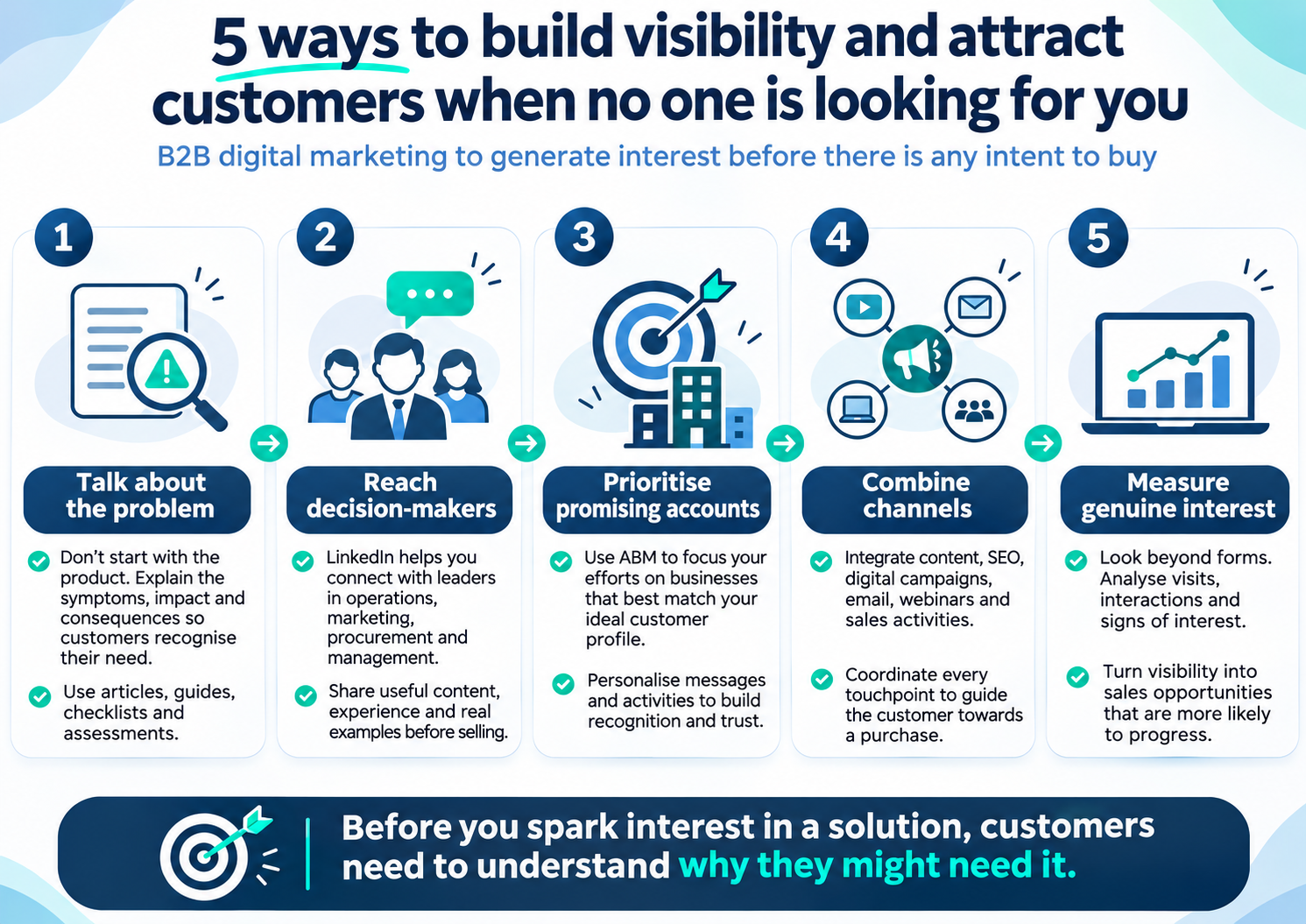
1. Talk about their concerns, not just your product
When people don’t know they need to change, they aren’t looking for technical features or benefits. They want answers to the issues they face every day. Instead of starting with what you sell, describe situations they can relate to.
For example, a cybersecurity company can explain how a security breach could affect business continuity, while a logistics company can discuss the impact of delivery delays on operating costs.
2. Use LinkedIn to talk to people, not to send sales pitches
Using LinkedIn for B2B connects you with decision-makers, even when they aren’t actively looking for a supplier. But building visibility isn’t about posting anything and everything or sending generic messages.
Sharing what you learn, analysing developments in your industry and discussing real examples helps build trust. Involving experts and leaders from your own business also helps: what they say as individuals feels more personal and credible than any corporate post. The aim is for your name to be familiar and trusted by the time a need arises.
3. Focus on the businesses that could actually become your customers
Reaching more businesses doesn’t always deliver better results. When your solution addresses a specific need, it pays to choose your audience carefully. Account-Based Marketing (ABM) helps you identify organisations that are an ideal fit for what you do and tailor your communications to their circumstances.
For example, if your strength is optimising processes, you can target businesses with complex structures or those going through a period of growth, using messages that address their everyday challenges. This shifts your focus from quantity to relevance: every interaction builds on the last and moves you towards generating qualified leads.
4. Coordinate your activities to turn interest into opportunity
In B2B, a purchase decision is rarely made after a single message. Someone might discover you through a LinkedIn post, read an article on your blog and later attend an event. If they show interest, your team — including B2B Inside Sales — can continue the conversation with a proposal tailored to them.
Each channel has a role: building awareness, providing more detail, establishing trust and making it easier to get in touch. When everything works towards the same goal, the relationship develops naturally and B2B Inbound Marketing reaches its full potential.
5. Pay attention to signals, not just contact enquiries
When you spark interest before someone is ready to request a quote, results don’t always come immediately. A business may visit your website several times, read your content or follow you for weeks before taking the next step.
Monitoring these details helps you understand which topics attract the most interest, who is moving forward and when it might be the right time to start a conversation. That way, you aren’t just counting how many contacts you generate: you are assessing whether you are reaching the right people and whether they are moving closer to a decision. That is the B2B performance measurement that really matters.
Don’t wait to be found: seek out your opportunity
When your proposition is new or solves a problem that businesses haven’t yet considered, B2B lead generation begins long before anyone fills in a form. It starts when a business recognises its concerns, discovers there is room for improvement and finds useful information to help it move forward.
At PGR Marketing & Tecnología, we help businesses across all sectors build strategies that combine content, targeted B2B campaigns, opportunity generation and personalised follow-up. We start with your circumstances and those of your B2B prospects to define what to say, where to say it and how to turn that interest into strong business relationships.
Want to reach people who don’t yet know your solution is what they need? Get in touch through pgrmt.com, and together we’ll build the B2B customer acquisition strategy your business needs.

