.webp)
When manufacturer, distributor and partner communicate differently, the market notices. A customer receives one version of the proposition from the brand, another from the distributor and a third from the partner supporting them. The result is not more information, but more uncertainty.
And when uncertainty appears, decisions slow down.
Questions also start to arise within the network itself: who should manage this opportunity? How far does each commercial relationship extend? What message should the customer receive? Who has priority over an account?
The problem is not usually a lack of involvement. In many cases, quite the opposite is true: everyone is doing something, but without a sufficiently clear framework defining who does what, what each party communicates and which objectives they share.
Aligning the network does not mean everyone doing the same thing. It means ensuring that each party understands the value they bring, where their role begins and ends, and how to collaborate with the rest without stepping on each other’s toes.
Why friction appears within the commercial network
Conflicts between manufacturer, distributor and partner rarely begin with a poor relationship from the outset. They usually arise when certain rules have not been clearly defined.
For example, when different information is communicated about pricing, timelines or capabilities; when two parties are targeting the same type of customer without realising it; when individual objectives clash; or when an opportunity arises and nobody is sure who should take responsibility for it.
Individually, these situations may seem isolated. When they happen repeatedly, however, they start to affect the business.
The customer perceives a lack of coordination and may delay their decision. The partner begins to feel that their role is unclear and may stop prioritising the brand. The distributor finds it harder to organise the relationship with its network, while the manufacturer loses visibility over what is really happening in the market.
Above all, opportunities are lost because nobody acts in time or because several parties try to manage them in different ways.
The principle is simple: ambiguity creates friction; clarity builds trust.
Defining everyone’s role: the foundation for avoiding conflict
Manufacturer, distributor and partner are all part of the same value chain, but they do not contribute exactly the same thing. That is precisely where the strength of the model lies.
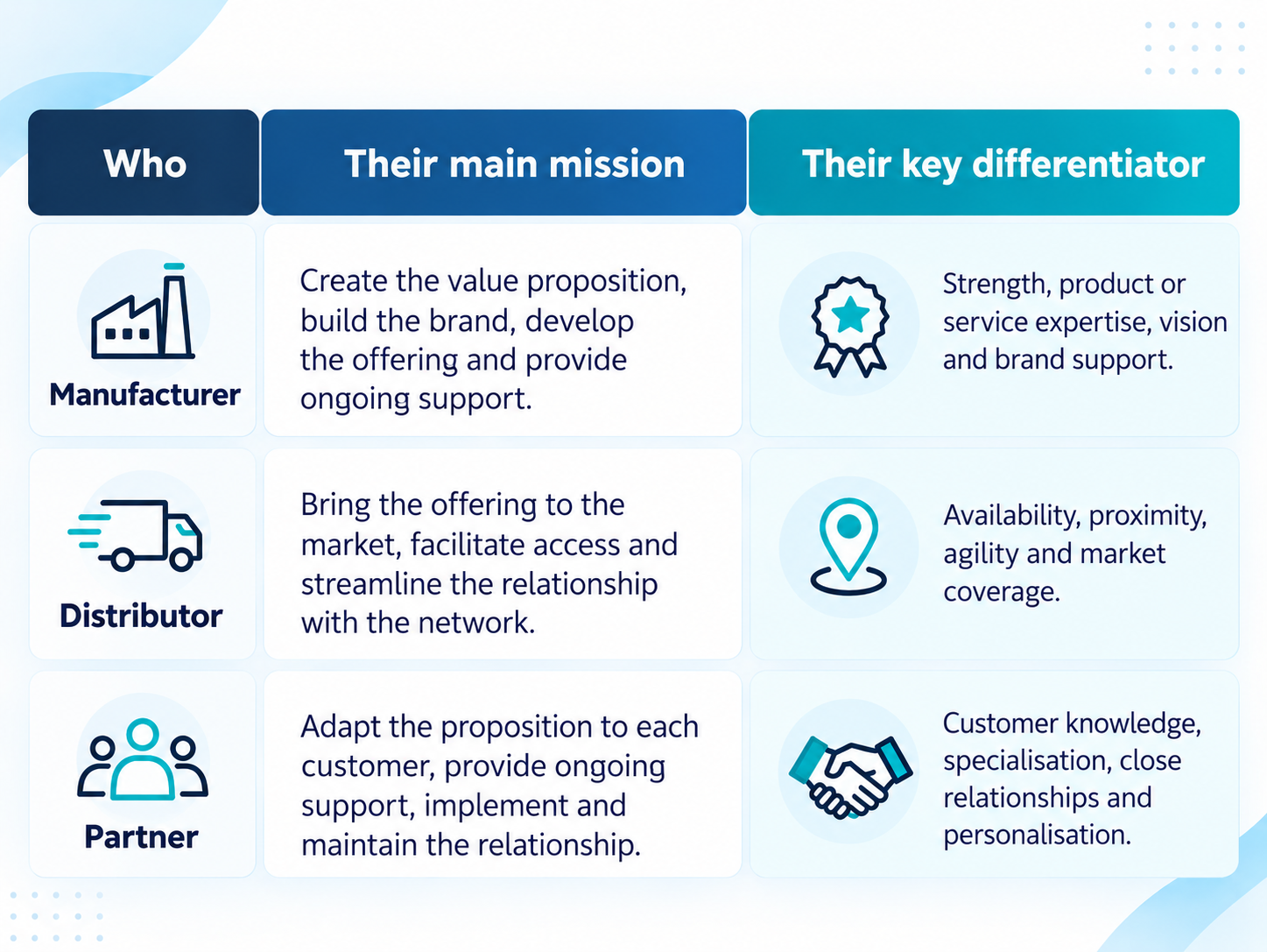
In a well-coordinated relationship, for example, the manufacturer may generate awareness and demand, the distributor provides resources and access to the ecosystem, and the partner turns that opportunity into a solution tailored to the customer’s specific needs.
They are not three companies trying to do the same thing. They are three different contributions to the same business opportunity.
That is why it is worth asking a very practical question: if we reviewed the sales presentations of the manufacturer, distributor and several partners today, would it be clear what value each one brings?
If they are all saying virtually the same thing, there is a clear risk of overlap.
Messages that complement rather than repeat each other
An aligned network needs consistency, but not uniformity.
There are certain elements that should remain consistent at every level: the value proposition, brand values, information about the product or service, and the commitments made to the customer.
There should be no contradictions here. What can change is how that proposition is presented depending on the role of each party.
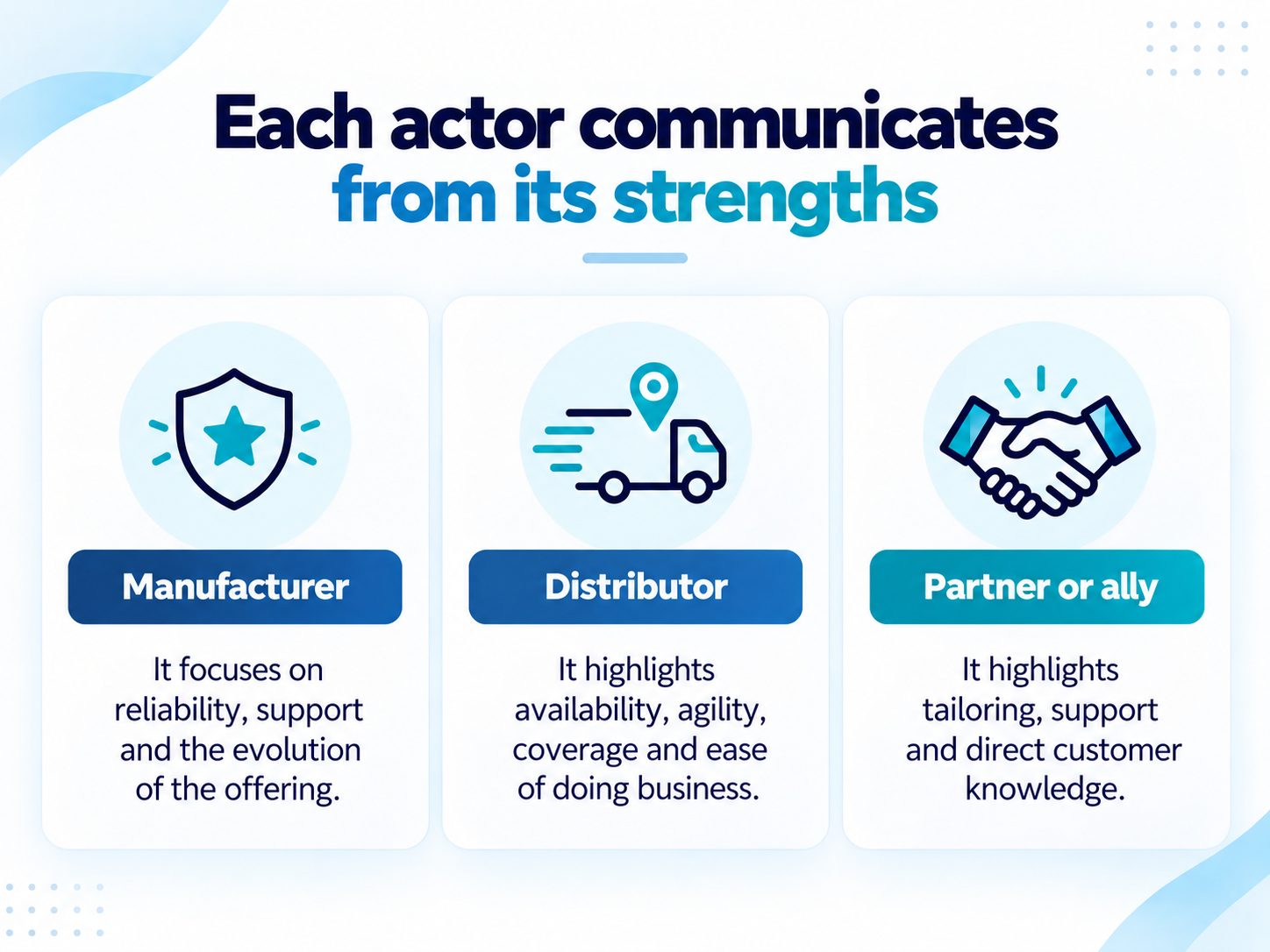
Everyone is communicating the same underlying proposition, but each party does so from its own area of strength.
This is particularly important because the customer does not need to hear the same argument three times. They need to understand what each party contributes to their project.
A useful way to achieve this is to develop a shared messaging guide. It does not need to be a complex document. It can simply define which messages should always remain consistent, which arguments belong to each profile and how they should be applied across campaigns, presentations, sales meetings or content.
This helps maintain consistency without removing the personality or specific value of each company.
Sharing objectives without forcing everyone to pursue the same goals
Alignment does not end with communication. It is also important to review how objectives are being defined.
Manufacturer, distributor and partner may share goals such as increasing market presence, generating new opportunities, improving the customer experience or developing specific areas of the business.
However, each party will also have its own indicators.
The manufacturer may be looking to increase penetration of its offering. The distributor may focus on expanding coverage or activating new partners. And the partner may prioritise customer acquisition, account development or customer retention.
That is not a problem in itself. The problem arises when those objectives conflict with one another. This is why it is advisable to agree from the outset what is expected from each party, which indicators will be used and how results will be reviewed.
Regular meetings also help identify deviations before they become conflicts. It is not simply a matter of reviewing figures, but of understanding what is working, where obstacles are emerging and what each party can do to support the others.
What happens when an opportunity crosses boundaries?
This is one of the most sensitive areas in any commercial network.
A manufacturer campaign generates a lead. A distributor identifies a need during a conversation. A partner spots an opportunity within an account they are already working with.
Who continues the conversation?
Trying to resolve this once the opportunity is already open can create tension. It is much easier to define the process in advance.
The network should be clear about which types of opportunities are managed by each party, when they are passed on, how they are recorded, who maintains the customer relationship and how each party’s contribution is recognised.
The more transparent this process is, the less room there is for interpretation. It also allows the network to respond more quickly.
The customer should not have to see all the complexity behind the commercial network. From their perspective, the experience should be simple: they raise a need, receive a consistent response and know who will support them throughout the process.
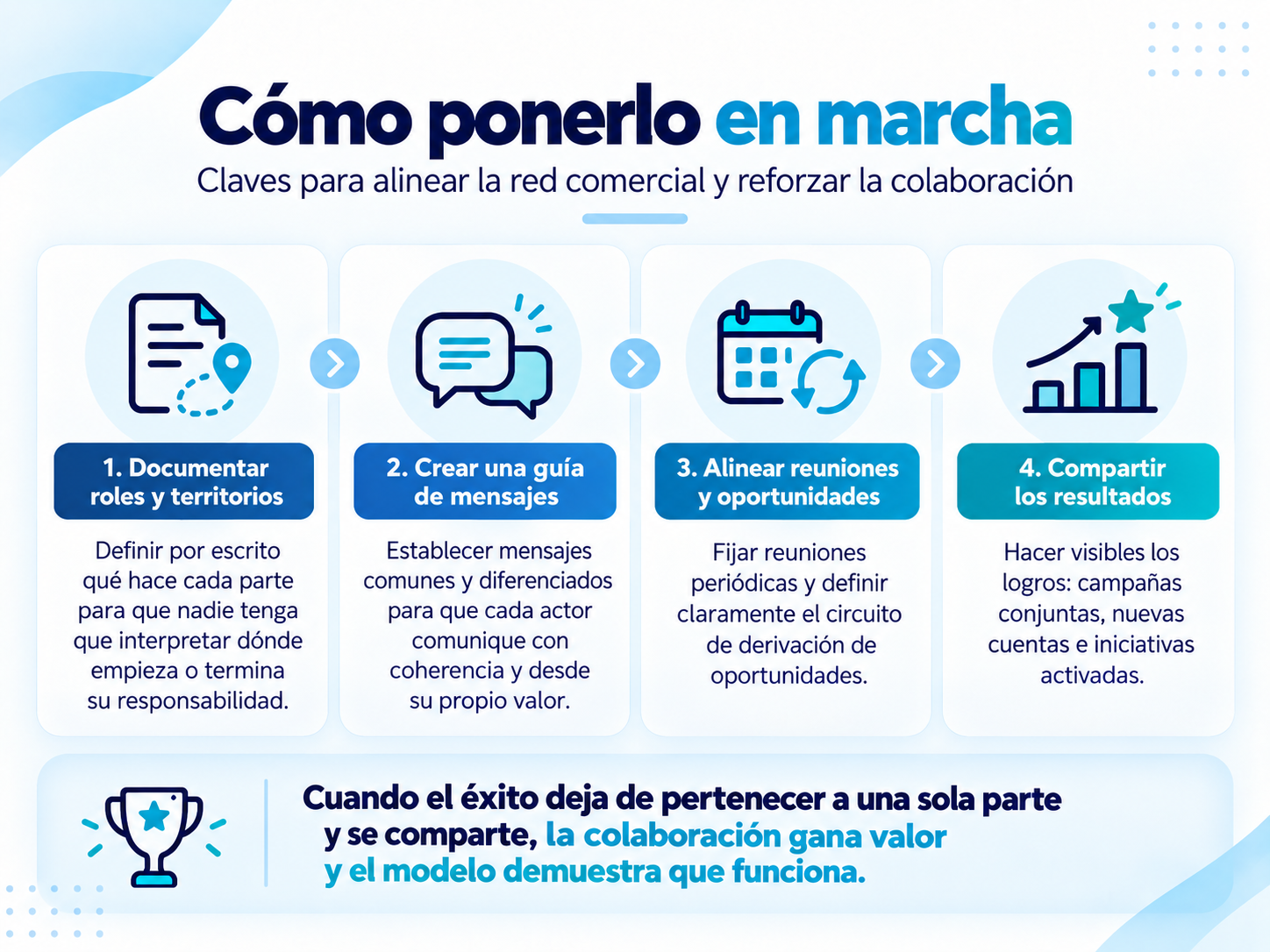
Actions to start improving coordination
There is no need to redesign the entire commercial model overnight.
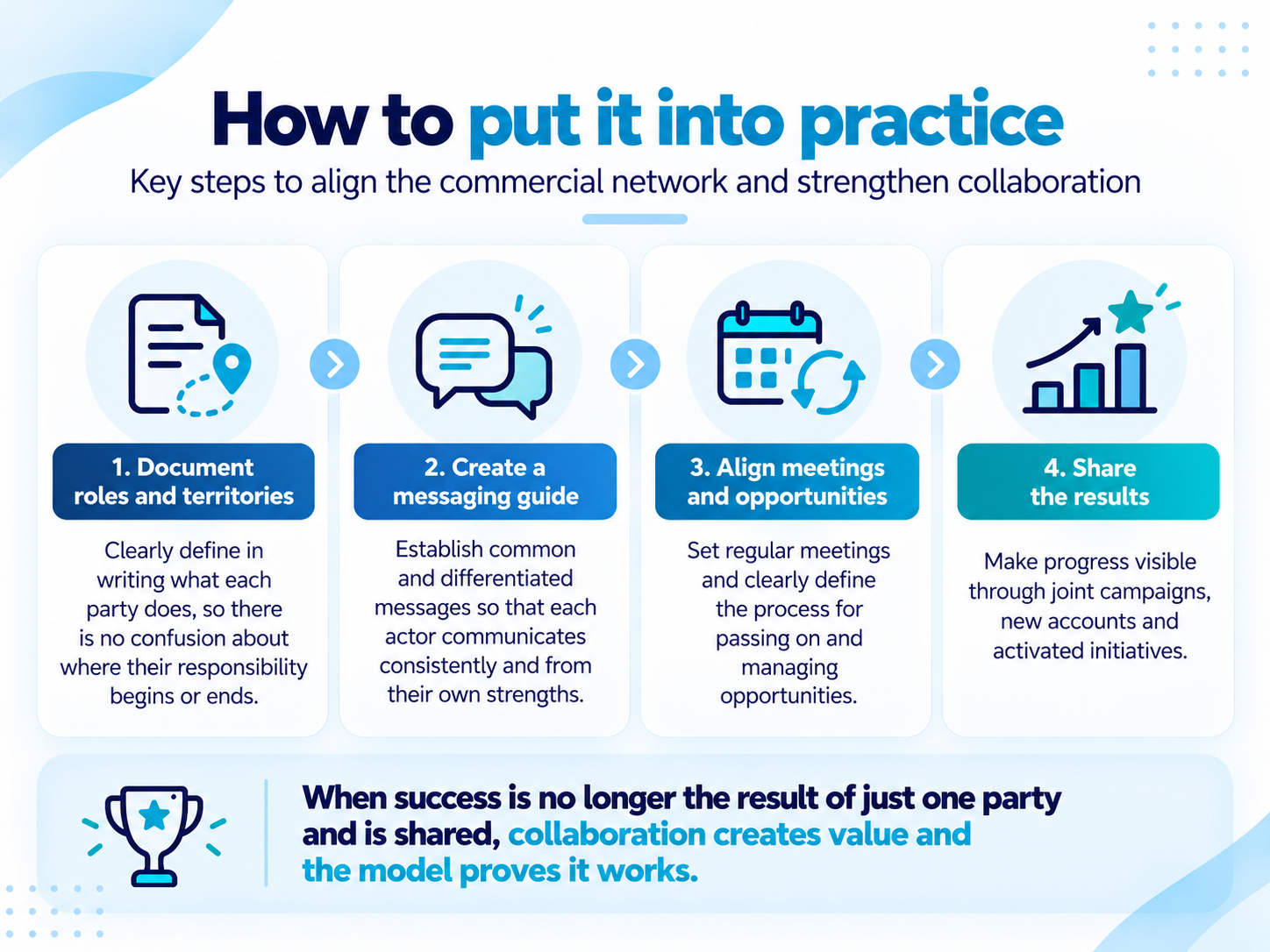
An aligned network is not one in which everyone does the same thing
It is a network in which everyone knows where they are heading and what is expected of them.
The manufacturer needs distributors and partners that understand its proposition and want to develop it. The distributor needs manufacturers that provide support and an active network. And the partner needs to feel that the structure behind them helps generate business rather than competing with them.
When roles, messages, objectives and opportunities are clearly defined, the relationship changes.
There is less friction, decisions are made more quickly and each party can focus on where they genuinely add value.
Because aligning manufacturer, distributor and partner is not about everyone rowing in exactly the same way. It is about everyone rowing in the same direction.
And that is where clarity starts to become trust, and trust becomes sustainable growth.
Could your commercial network work with greater coordination?
At PGR Marketing & Technology, we help manufacturers, distributors and partners develop channel strategies designed to generate opportunities, activate the network and improve collaboration between the different parties involved.
We define processes, messages and actions so that each party understands its role and adds value within a shared strategy. Let’s talk about how to activate and align your commercial network.