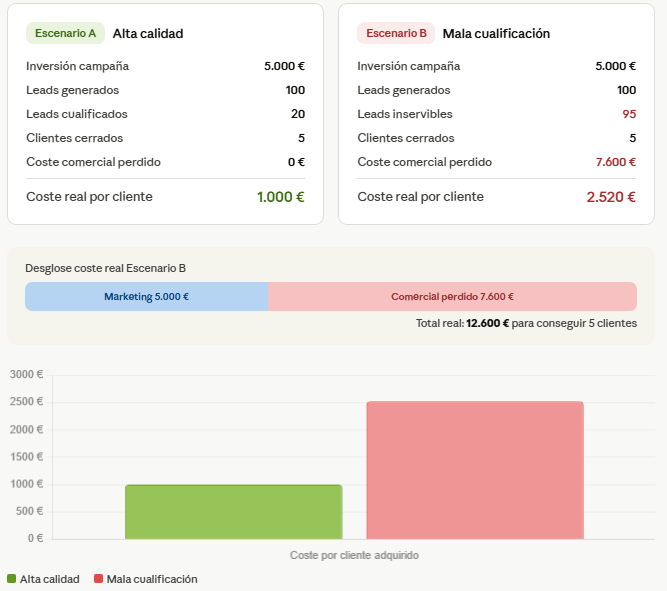
Your sales team has spent three weeks chasing a company that never had the budget to buy from you. Three weeks of calls, emails, demos prepared and time they’ll never get back. How much has that really cost? Far more than the price of the lead.
In the IT sector, where sales cycles are long and sales resources are limited, a poorly qualified lead isn’t a “minor failure”. It’s a hidden leak that drains your team’s resources, distorts your CRM and makes your marketing ROI look better than it really is.
The cost you can see: the acquisition cost
In B2B, generating a qualified lead isn’t cheap. Depending on the segment — consulting, software, technical services — the cost per lead (CPL) ranges from €30 to more than €350. So far, everything is under control: there’s a figure, a budget and a metric.
CPL = Total campaign investment ÷ Number of leads generated
Example: €5,000 invested ÷ 100 leads = €50 per lead
The problem arises when that lead doesn’t match your ideal customer profile. The marketing report still shows a reasonable CPL, but nobody accounts for what happens afterwards: sales time, demos that go nowhere, unanswered emails…
What every useless lead really costs your sales team
This is where the real problem lies. When a poorly qualified lead reaches the sales team, the real damage begins.
- Wasted sales hours
An SDR or Account Executive who spends four hours making calls, sending follow-ups and preparing a demo for someone who has no budget, authority or genuine need — the classic BANT framework — is generating a direct cost. If that salesperson costs €50 per hour, those four hours amount to €200 wasted. On a single lead.
- Team morale hits rock bottom
The conversion rate of poorly qualified leads is close to zero. When a sales team works week after week without closing deals, it isn’t just a numbers issue: it leads to demotivation, staff turnover and the loss of talent that costs far more to replace.
- A pipeline that looks healthy but isn’t
Poor-quality leads fill up the CRM. Opportunities appear more genuine than they really are in the pipeline. And when the end of the quarter arrives, forecasts fall short. Strategic decisions are made on the basis of data that was never reliable in the first place.
An example with real numbers
Imagine an IT company that invests €5,000 in a campaign and generates 100 leads at €50 per lead.
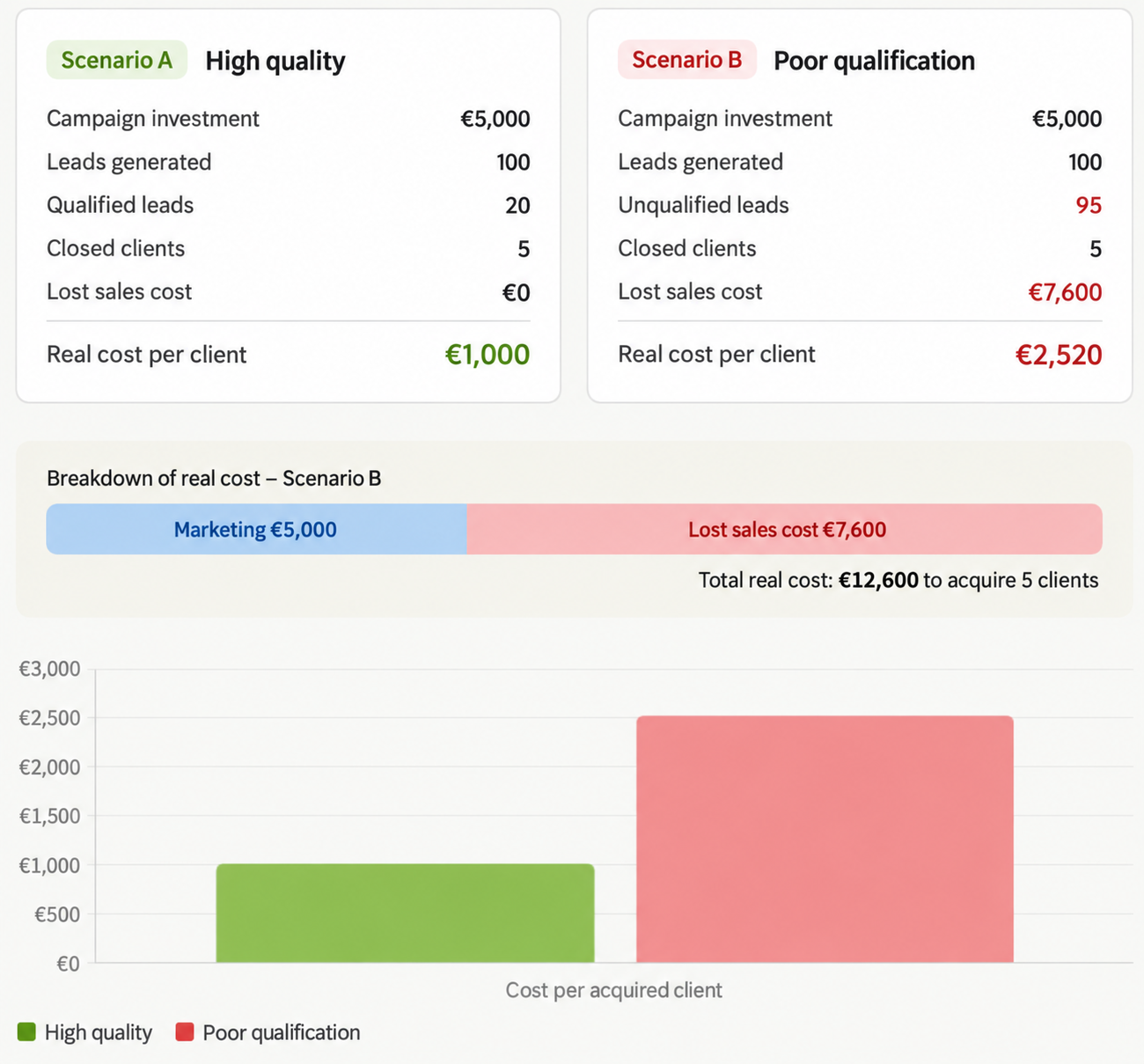
The initial investment was €5,000. The real cost ended up exceeding €12,000. And the five customers who did buy only did so after a disproportionate amount of effort.
How to prevent this from happening to you
It isn’t about generating fewer leads. It’s about generating the right leads:
- Qualification from the outset
Use forms with questions that filter prospects from the start: job title, company size, available budget and purchasing timeframe. A longer form reduces volume, yes. But every lead that comes through already has some value.
- Genuine alignment between Marketing and Sales
The concept of “smarketing” isn’t a trend: it’s the only way to ensure that both teams work with the same definition of an MQL (Marketing Qualified Lead). Without that agreement, each department optimises for its own metrics.
- The 95/5 rule
Only 5% of your market is actively looking to buy right now. The other 95% isn’t ready. Trying to force that 95% to convert is precisely what generates poor-quality leads. The smarter strategy is to nurture that 95% with valuable content until the right moment arrives.
Is your sales team wasting time on leads that are going nowhere?
At PGR, we have years of experience designing B2B lead generation strategies for the IT sector that attract qualified leads and optimise the funnel from the very first interaction. If you want to stop wasting resources and start generating genuine business opportunities, let’s talk.