



Many companies invest in LinkedIn, organise events, publish content, launch email marketing campaigns or work on their website’s search engine visibility. However, when they analyse the results, a common question arises:
Why are we still not generating the business opportunities we expected?
Generating more opportunities does not depend on a single channel. It depends on how you combine them
In the B2B market, purchasing decisions are complex. Several stakeholders are involved, sales cycles are long, and trust carries as much weight as the solution itself. Expecting a single channel to generate a sales opportunity on its own often leads to frustration.
The companies that achieve the best results are not those that carry out the most activities, but those that manage to get all their channels working as part of a single strategy.
Think about how an IT decision-maker buys today:
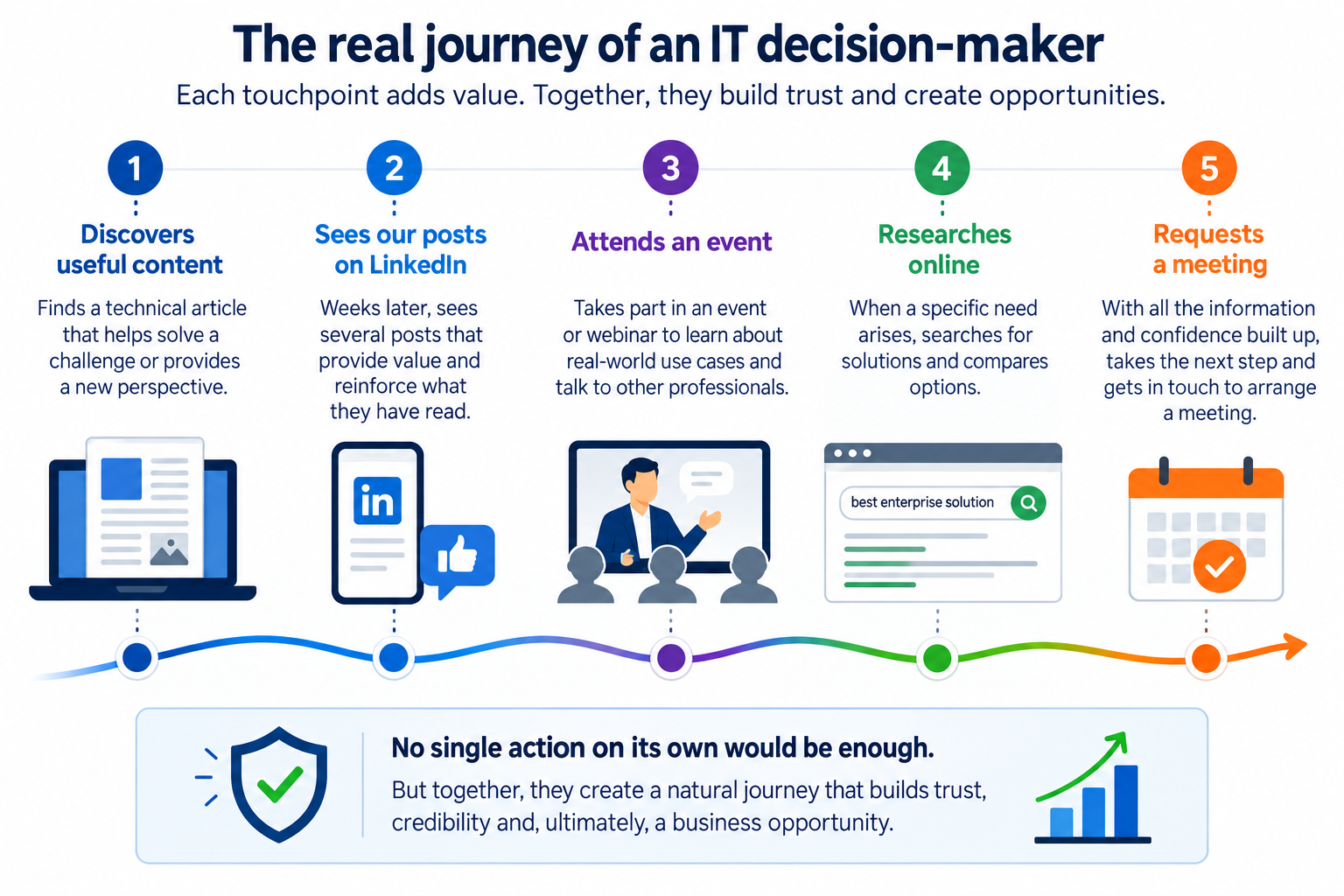
So instead of asking which channel works best, the real question is:
What role should each channel play within our strategy?
Each channel has a different role
Not all channels pursue the same objective. Understanding the role of each one makes it possible to build a much more natural buyer journey.
- Account-Based Marketing: engaging strategic accounts
When selling high-value solutions where several stakeholders are involved in the decision, the objective is not to generate thousands of contacts, but to develop relationships with the companies that really matter.
Account-Based Marketing (ABM) makes it possible to personalise communications for each account, adapting messages according to their needs, where they are in the buying journey and the different stakeholders involved. Rather than generating volume, it helps focus efforts where there is greater business potential.
- Events: turning interest into trust
In the IT sector, trust remains one of the most important factors when starting a business relationship. Technology breakfasts, round tables and exclusive events create an environment where attendees can share experiences, resolve questions and learn about real-world cases without the pressure of a sales presentation.
Often, a one-hour conversation can generate more opportunities than dozens of advertising touchpoints.
- Technical content: answering questions before Sales has to
Technology decision-makers carry out extensive research before contacting a supplier. They need to understand trends, compare alternatives, explore success stories and assess risks. Guides, reports, comparisons, studies and checklists help answer these questions while positioning the company as an expert in its field.
Content does not sell directly. It builds credibility.
- LinkedIn: keeping the conversation alive
LinkedIn has become one of the main meeting points for the technology sector. But automated messages are no longer what makes the difference. What matters is the ability to consistently provide valuable knowledge.
Sharing useful content, taking part in relevant conversations and maintaining an active presence helps keep the company front of mind with decision-makers until a genuine need arises.
- SEO: being present when the customer is already looking for a solution
There is a particularly valuable moment in the buying process: when the problem has already been identified and the search for suppliers begins.
At that point, appearing on Google with content targeting high-intent searches can significantly accelerate the start of a sales conversation.
SEO does not replace the other channels. It complements them.
The real value emerges when they all work together
This is where many strategies make the difference.
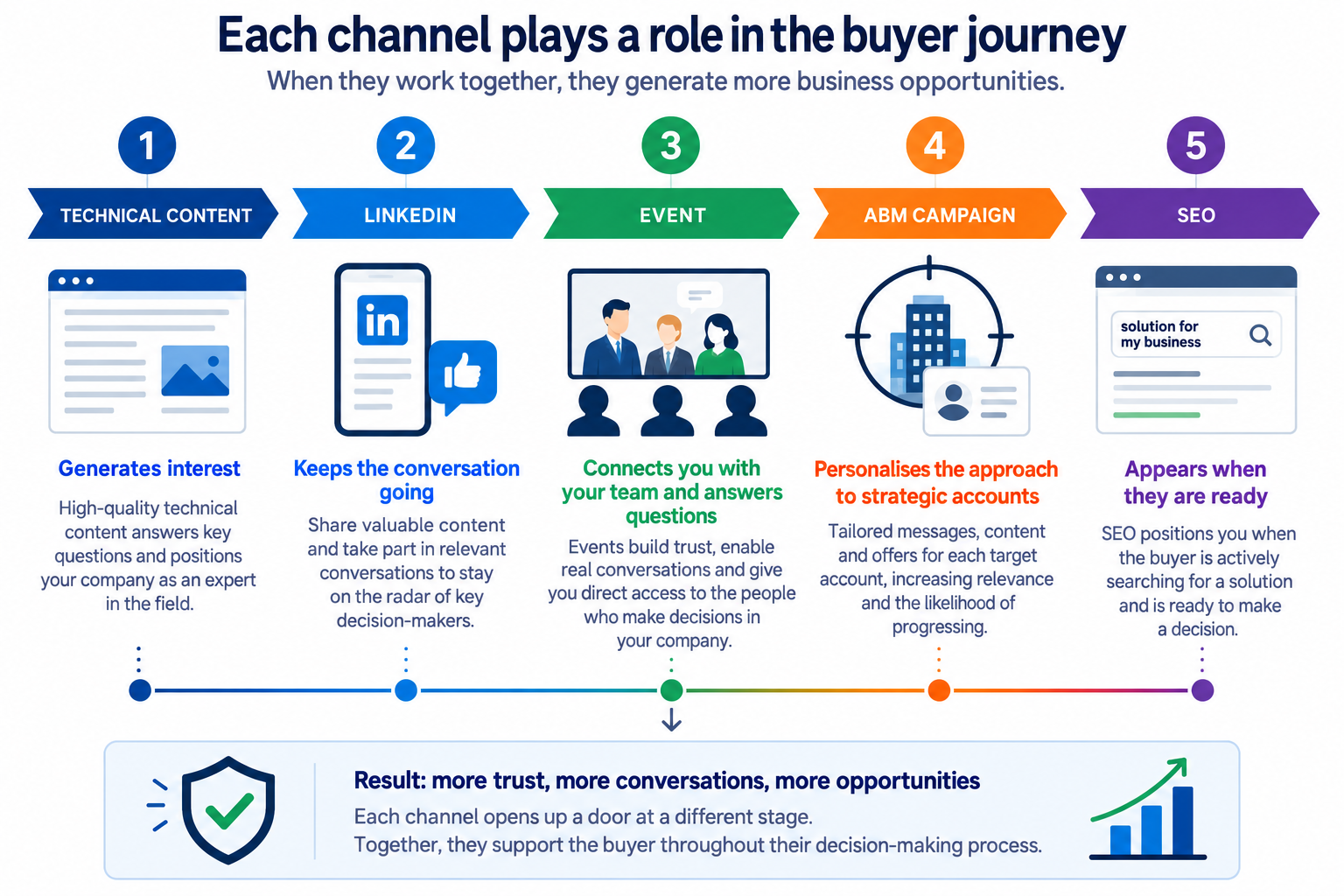
Each channel has a different role, but they all pursue the same objective: guiding the buyer throughout their decision-making process.
What a multichannel strategy could look like
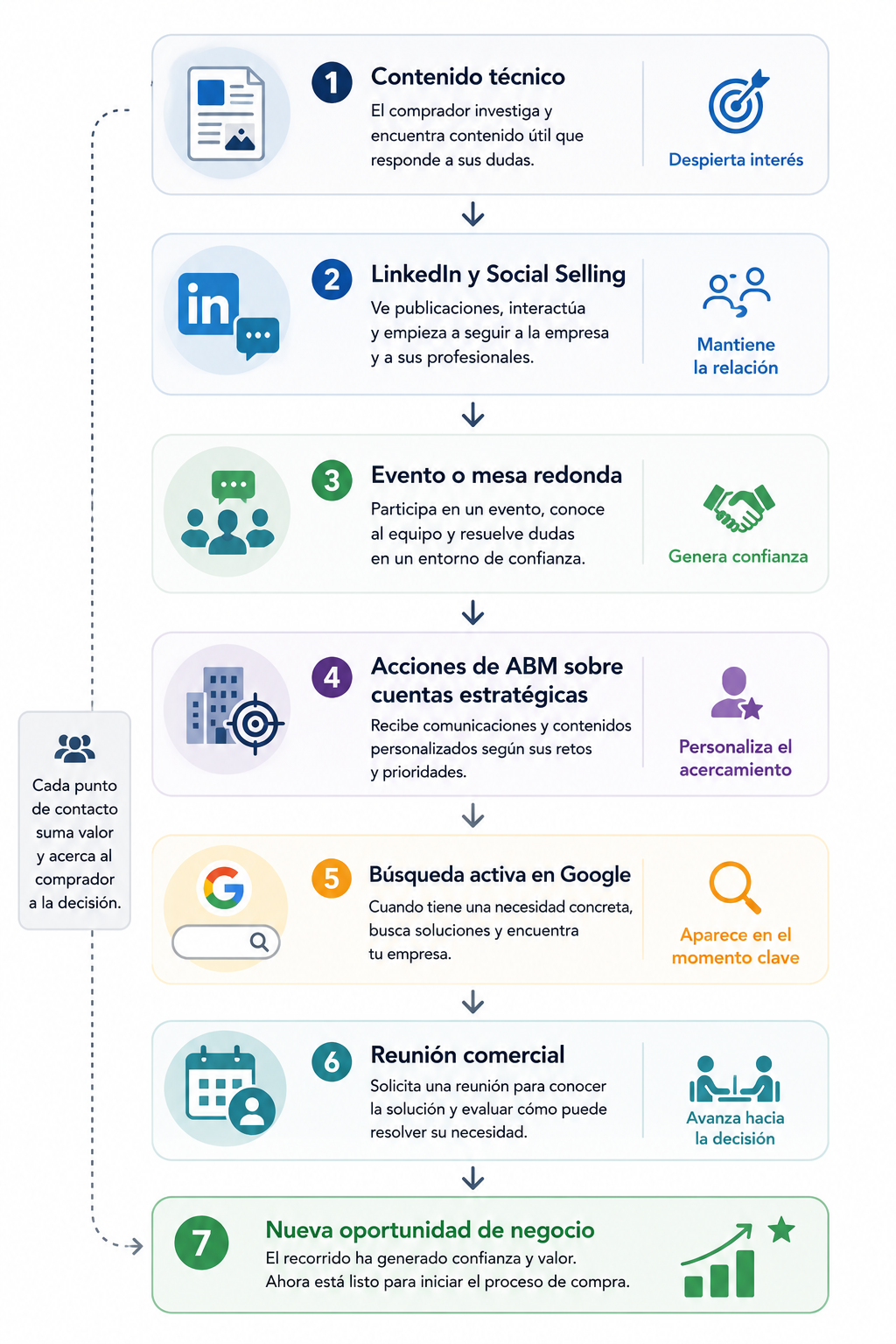
Not every company will follow exactly the same journey.
What matters is ensuring continuity between each touchpoint.
How to know whether your channels are working in the same direction
Before launching new campaigns, it is worth asking a few questions:
- Does each channel have a clear objective within the strategy?
- Does the content address the real concerns of IT decision-makers?
- Are events part of a follow-up plan, or do they end when the lights go out?
- Does LinkedIn reinforce the expertise demonstrated through your content?
- Are ABM activities supported by previous insights and conversations?
- Is SEO attracting searches with genuine purchase intent?
If several of the answers are no, the problem is probably not the budget or the channel you have chosen, but the lack of connection between all your activities.
The best strategy is not about doing more, but connecting better
There are no miracle channels in B2B marketing. What really makes the difference is building a strategy where every action has a purpose and reinforces the others.
When content builds authority, LinkedIn maintains the relationship, events create trust, ABM personalises the approach and SEO captures demand at the right moment, business opportunities stop depending on isolated activities and become the result of a much more consistent process.
Are your channels working together, or is each one going its own way?
At PGR, we help manufacturers, distributors and companies in the IT sector design B2B marketing strategies where content, events, Account-Based Marketing, digital campaigns and automation work together to generate real business opportunities.
If you want to discover how to connect all your channels to attract higher-value accounts and turn them into sales opportunities, get in touch with our team. We will be happy to analyse your strategy and help you get the most out of every activity.

