



Your team spent weeks defining the ideal customer profile, analysing purchase intent signals and selecting the accounts with the greatest potential. Marketing did its job. Sales managed to open conversations. Everything suggested that the opportunity would eventually turn into business.
But months go by and the account remains stalled.
There is no clear rejection. Nor is there a final decision. Meetings become less frequent, new stakeholders appear and the process seems to move forward in slow motion. Meanwhile, the pipeline continues to show an open opportunity that never quite materialises.
Many large technology accounts are not lost because they were poorly identified. They are lost because, once identified, no one properly manages the complexity of their buying process.
The problem isn’t finding the account. It’s getting it to move forward
Account-Based Marketing (ABM) strategies have helped many IT companies move away from mass lead generation and focus their efforts on organisations with high business potential.
However, there is a false sense of security when an account meets all the ICP criteria.
We assume that because the company is a good fit, the rest of the process will be easier.
The reality is exactly the opposite.
The more strategic an account is, the more complex its buying process tends to be. More people are involved in the decision, more internal approvals are required, and it becomes easier for an opportunity to go cold without anyone identifying why.
That is why the problem is often not targeting. It is execution.
When the problem isn’t the account, but the process
Identifying an account with potential does not guarantee that it will become a customer. In fact, many strategic opportunities are lost when the most important work already appears to have been done.
In large technology organisations, decisions move slowly, multiple stakeholders are involved and priorities can change several times throughout the process. In this context, small execution errors can end up holding back opportunities that seemed perfectly on track.
These are five mistakes that frequently appear in ABM strategies and can turn a promising account into an opportunity that remains stalled for months. Most importantly, all of them can be prevented if they are identified in time.
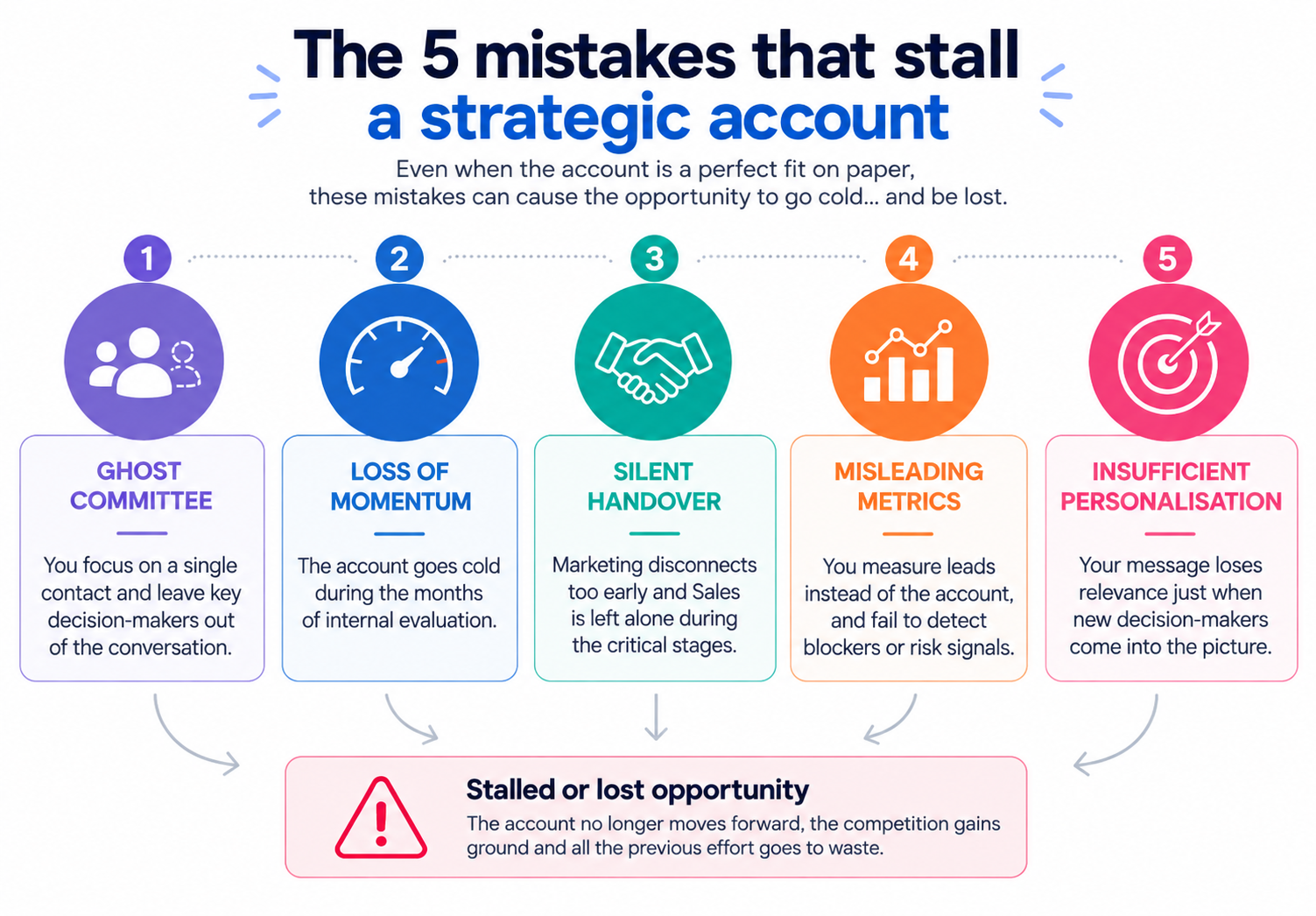
Mistake 1.- Assuming your contact is the decision-maker
One of the most common mistakes is building the entire relationship around the first person who shows interest.
This is usually a technical manager, IT director or specialist who has attended a meeting or downloaded a piece of content.
The opportunity moves forward and everything seems to be going well. Until new stakeholders appear.
Procurement wants to review the terms. Finance needs to justify the investment. The cybersecurity manager raises additional requirements. Legal requests compliance documentation.
Suddenly, the account no longer depends on a single person.
In reality, it never did.
Most significant technology decisions are made by a committee. The sooner all the stakeholders involved are identified, the easier it will be to tailor the message and anticipate objections.
Mistake 2.- Disappearing during periods of inactivity
Technology sales cycles can last for months.
However, many companies concentrate most of their efforts at the beginning of the process: campaigns, meetings, demonstrations and sales follow-up.
Then comes the silence.
The account enters an internal evaluation phase and the brand stops providing value. For weeks or even months, there is barely any interaction.
The problem is that the decision is still moving forward, even if we cannot see it.
Decision-makers compare suppliers, review proposals and build internal consensus. If we disappear from their radar during this period, we leave room for others to take our place.
Strategic accounts need a consistent cadence of contact, with content and conversations tailored to each stage of the process.
Mistake 3.- Thinking Marketing ends when Sales begins
Many organisations still operate as though Marketing’s job ends the moment an opportunity is handed over to the sales team.
With large accounts, this separation often becomes a problem.
The most delicate stages of the buying cycle usually come after the initial meetings: comparisons, RFPs, technical validations, financial analysis or negotiations.
This is precisely where Marketing can continue to add value.
Success stories, technical documentation, comparisons, industry studies or tools that help justify return on investment can strengthen the sales position and make it easier to build consensus within the customer organisation.
When AB throughout the entire cycle, the chances of closing increase significantly.
Mistake 4.- Measuring contacts when you should be measuring influence
Many companies still evaluate their ABM initiatives using metrics inherited from traditional demand generation.
MQLs, email opens or individual responses can be useful, but they provide an incomplete picture when dealing with strategic accounts.
The question is not how many contacts have interacted.
The question is how far the account has progressed.
Are several members of the buying committee involved? Are there key stakeholders who have not yet interacted? Is the level of influence within the organisation expanding?
Measuring the progress of the account as a whole makes it possible to identify bottlenecks before the opportunity goes completely cold.
Mistake 5.- Reducing personalisation when it matters most
Personalisation is usually a priority during the early stages of ABM.
However, as the process progresses, many companies revert to generic messages, standard presentations and poorly tailored sales materials.
This is a particularly costly mistake.
The final stages are precisely when a higher level of personalisation is required. New decision-makers join the process, and each one needs different information to make a decision.
The finance lead wants to understand the return on investment. The security team needs technical assurances. Legal is looking for evidence of regulatory compliance.
Personalisation should not decrease over time. It should increase.
The key is managing the account, not just selecting it
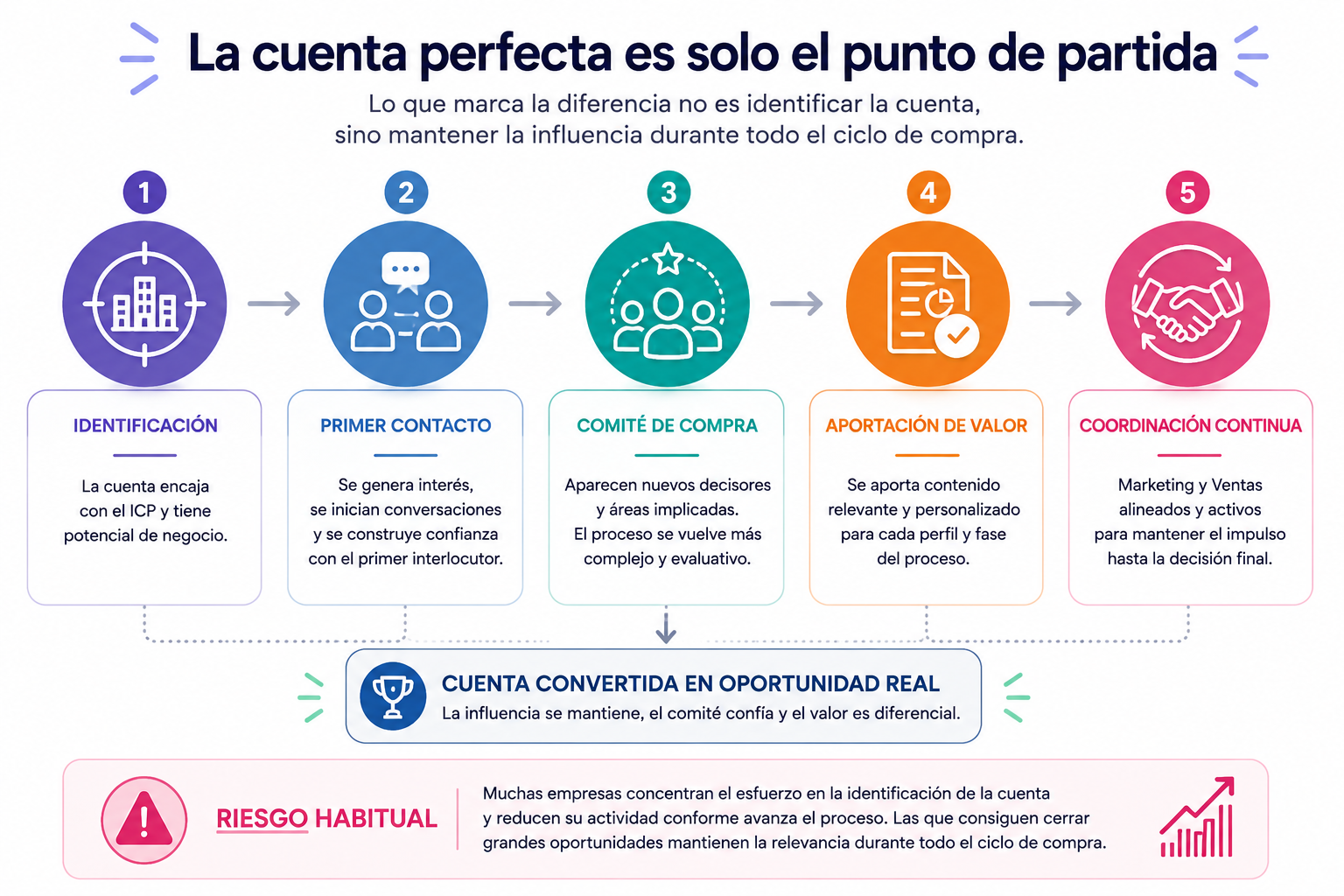
Identifying strategic accounts is the first step in an ABM strategy. But it is not the most difficult one.
The real challenge is maintaining relevance throughout the entire sales cycle, understanding how the buying committee evolves and continuing to provide value when the decision is still a long way from being made.
The accounts that generate the most business are often also the ones that require the most patience, coordination and deeper personalisation.
Are your strategic accounts progressing or simply remaining open?
If you have opportunities that have been sitting in the pipeline for months without any clear progress, the problem may not lie in account selection, but in how the buying process is being managed.
At PGR Marketing & Technology, we help manufacturers, distributors and IT companies design ABM strategies focused on generating real business opportunities, aligning Marketing and Sales throughout the entire sales cycle.
Let’s talk and analyse together what is holding back your strategic accounts.

