



Imagine a company needs to purchase a cybersecurity solution. Its IT manager has spent weeks researching, compared several vendors and already has two or three favourites. By the time they finally request sales information, much of their decision has already been made. If your company is not among their options, you may never even have the opportunity to present your proposal.
This behaviour is changing the B2B buying process. For marketing teams, the challenge is to make sure potential customers know their brand and consider it before the first sales conversation takes place.
B2B buyers research before making contact
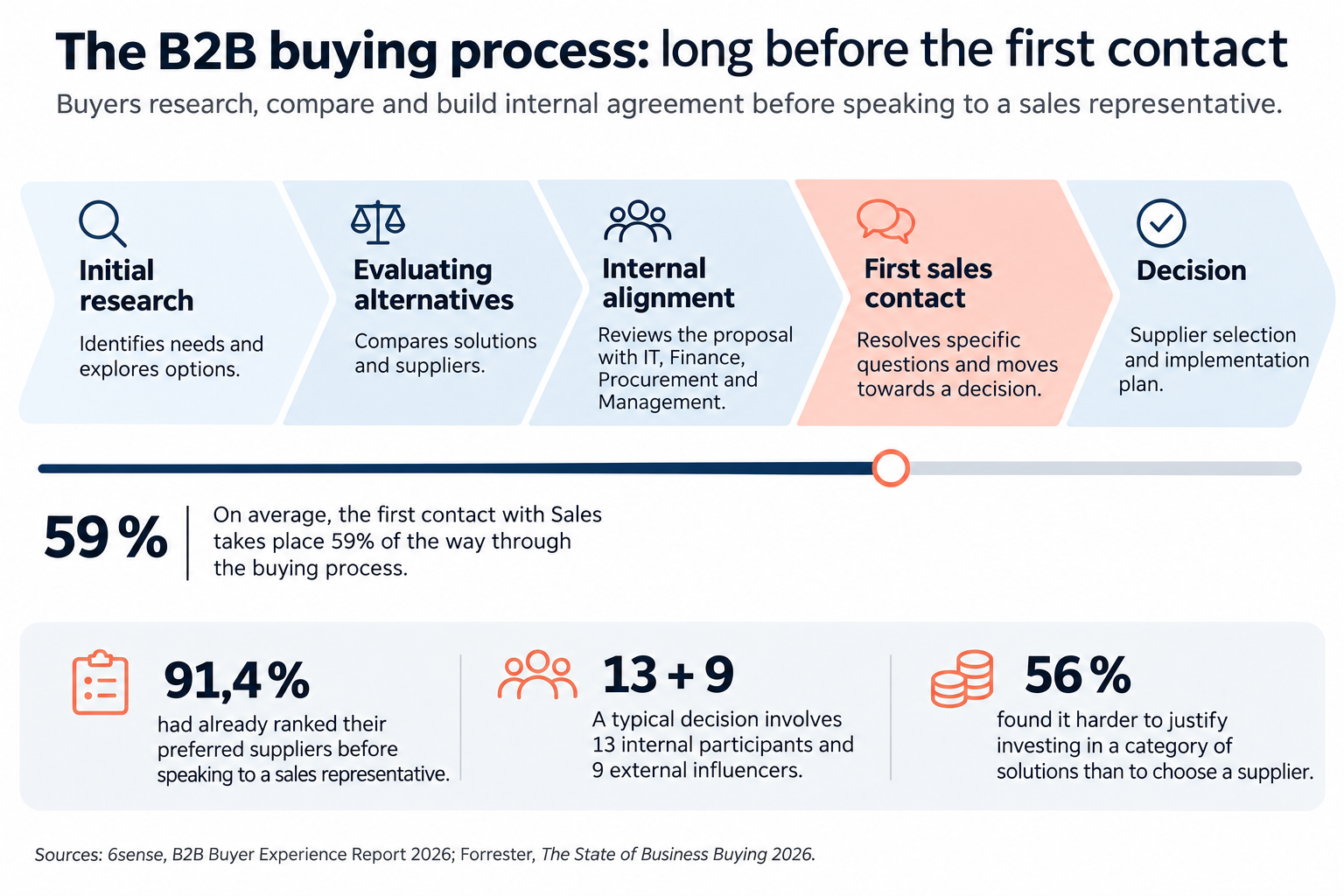
According to the 6sense B2B Buyer Experience Report 2026, 91.4% of buying groups had already ranked their preferred suppliers before speaking to a sales representative. The study also finds that, on average, the first contact takes place 59% of the way through the buying process.
During this time, buyers consult specialist content, compare technologies, seek recommendations and assess different options. Much of this activity takes place without suppliers being able to identify who is doing the research.
For technology vendors, distributors and systems integrators, this represents a significant shift: campaigns focused exclusively on generating sales enquiries may reach customers when their preferences are already fairly well established.
That is why it makes sense to build brand visibility and reputation long before an opportunity appears in the CRM.
AI changes the research process, but does not replace trust
Artificial intelligence tools are playing a growing role in supplier research. Buyers can use them to compare solutions, look up technical specifications or identify alternatives without visiting vendors’ websites directly.
A Gartner survey published in 2026 reports that 45% of the B2B buyers surveyed used generative AI during a recent purchase.
However, 69% prefer to verify the information obtained through these tools with sales representatives.
This shows that independent research does not remove the need for specialist advice. Buyers still need reliable references, answers to specific questions and reassurance before committing to an investment.
Appearing in search results or AI-generated answers can help you make the supplier shortlist. But to stay on it, you will need to demonstrate that you understand the buyer’s needs and that your solution can meet them.
The challenge also lies within the buying organisation
Getting a customer to consider a solution does not guarantee they will eventually buy it. Technology decisions often involve several departments with different interests.
Forrester’s The State of Business Buying 2026 report states that a typical B2B purchase involves 13 internal participants and nine external influencers.
Consider a company looking to purchase a managed SOC service. The head of Security needs to understand its detection and response capabilities. IT wants to check how it will integrate with the existing infrastructure, while Finance needs to justify the budget.
Although they are all assessing the same solution, their priorities differ.
In fact, according to 6sense, more than half of the buyers surveyed found it harder to justify the need to invest in a category of solutions than to choose a particular supplier.
This gives marketing an opportunity: create content that helps buyers make the internal case for their choice, providing technical information, comparisons and financial arguments tailored to each stakeholder.
How to make sure your brand is among the buyer’s options
Being present during the customer’s research means understanding what information they need, where they look for it and which criteria they use to compare suppliers. These are some actions that can help technology companies become part of that selection.
- Answer the questions buyers are actually asking
- Review the information buyers find about your company
- Provide arguments to justify the investment
- Prepare your partners to take part in the decision-making process
Content focused exclusively on features does not always address the questions that arise during a purchase.
A cloud provider could publish a comparison of the total cost of a migration, including maintenance and potential additional expenses. A cybersecurity company could explain when it makes sense to use a managed SOC service and when to retain an in-house team.
This type of content allows you to demonstrate expertise and help buyers assess alternatives, even before they become familiar with a particular solution.
Publishing content across different channels is not enough. It is important to check that the information available is consistent and up to date.
For example, a vendor may have updated its sales proposition while its distributors continue to use old presentations. If buyers find different messages on the website, LinkedIn or through a partner, they will find it harder to assess the solution.
Regularly reviewing product pages, sales messaging and channel materials helps identify these inconsistencies and correct them before they affect an opportunity.
Buyers need information they can share with those who approve the budget.
A technical comparison can help them select a solution, but Finance may need to understand the total cost of ownership or the expected return. Cost calculators, evaluation guides and use cases can make these internal conversations easier.
The aim is to give buyers clear arguments to explain why a solution meets their organisation’s needs.
In the IT sector, vendors, distributors and systems integrators may be involved at different stages of a purchase.
That is why partners need materials that help them explain how a solution differs from other options, respond to objections and justify the proposal to technical and business stakeholders.
Sharing up-to-date sales messaging, organising training sessions and coordinating campaigns allows channel partners to approach sales opportunities better prepared.
Marketing and Sales need to act at the right time
If a potential customer already understands a solution’s basic features, they probably do not need another general presentation. A discussion about integration, costs, specific requirements or implementation arrangements may be more useful.
Marketing should provide information during the research process, while Sales can focus on answering questions and supporting the evaluation.
This coordination also requires measuring more than leads and downloads: qualified meetings, sales opportunities and the contribution campaigns make to the pipeline.
Your next customer may be comparing suppliers right now. Whether your company is among them will depend on the information they find, the trust your brand builds and the arguments they can use to justify their decision.
At PGR Marketing & Tecnología, we help vendors, distributors and systems integrators develop B2B marketing strategies focused on generating demand and sales opportunities.
Want potential customers to consider your company from the earliest stages of the buying process? Contact us and find out how we can help.

