



The meeting went well. Your team presented the solution, the client’s technical stakeholders showed interest, and everything seemed to suggest the opportunity was moving in the right direction. Yet weeks go by and there is no progress.
When you ask what is happening, you receive an unexpected answer: “The technical team is convinced, but senior management still isn’t clear on what we stand to gain from this investment.”
And that is the problem. Your proposition may be technically excellent, but if those involved in the purchasing decision do not understand its value, it is unlikely to move forward.
One proposition, several stakeholders
B2B purchasing decisions rarely rest with just one person. They involve people with different responsibilities and, therefore, different priorities.
An IT manager will assess security, compatibility and performance. A finance director will analyse costs and return on investment. And an operations manager will want to know how the solution will affect the way their business runs.
If the presentation focuses solely on technical specifications, some members of the buying committee may be left without the arguments they need.
This can lead to opportunities losing momentum, longer sales cycles and sales teams having to justify the value of the proposition repeatedly.
How to explain a complex solution without losing its value
The key is to organise information around the client’s needs, rather than trying to explain everything from the outset.
Imagine a company presenting a cyber resilience solution by highlighting its immutable backup, replication and automated recovery capabilities.
These terms will be familiar to an infrastructure specialist. But a business director may be more interested in understanding how that technology helps reduce disruption and supports recovery following a cyber attack.
A practical way to structure the message is to divide it into three levels:
1. The problem and its business impact. Explain the need the solution addresses and the benefits it can deliver.
2. How it works. Present its main capabilities and relate them to real situations.
3. The technical detail. Keep specifications, certifications and integrations for those who need to explore the solution in greater depth.
This allows each stakeholder to find the information they need without having to work through unnecessary explanations.
From features to benefits
One of the most common mistakes in B2B communication is assuming that clients automatically understand the advantages of each feature.
For example, here are three ways to turn technical language into messages focused on the client’s needs:
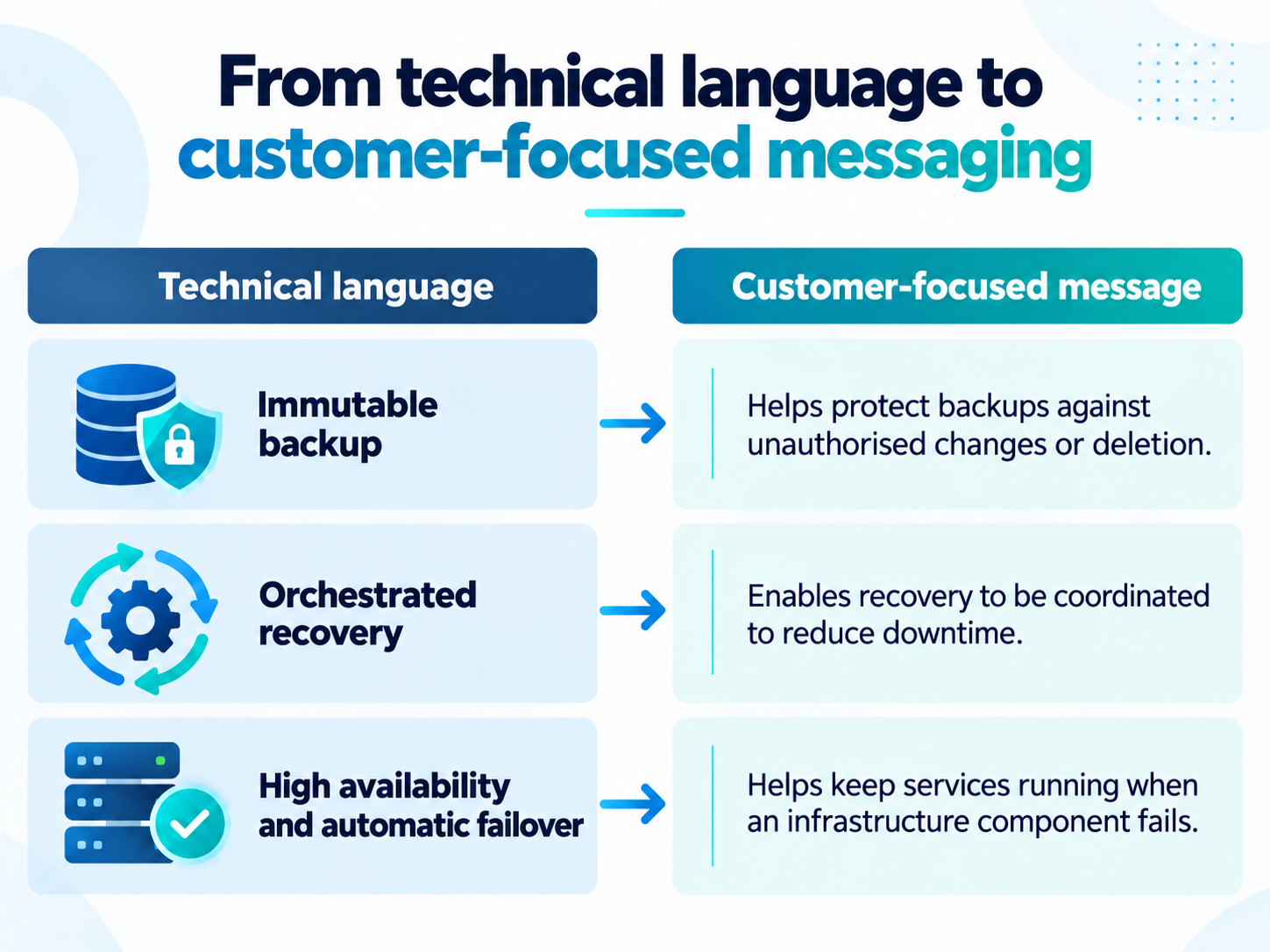
Although these examples come from the technology sector, the same principle applies to any B2B company that needs to explain complex products, services or processes.
Specifications build credibility, but benefits help people understand their usefulness.
Whenever possible, messages should also be supported by data, examples or use cases. Instead of stating that a solution “improves efficiency”, explain which process it speeds up, which tasks it automates or how much time it can save.
The more specific the message, the less the client has to work out for themselves.
Your proposition needs to make sense even when you are not in the room
Many of the conversations surrounding a B2B purchase take place after the sales meeting.
Your contact shares the information with senior management, consults other departments or needs to justify the investment internally. And you will not always be there to answer their questions. That is why marketing content and sales materials need to convey a consistent proposition that is easy to share.
This requires coordination between marketing, sales and, where involved, the distribution channel. If each team uses different arguments, the client may receive conflicting messages that make their decision more difficult.
A well-defined value proposition makes it easier for everyone to communicate the same benefits while adapting them to each context.
When the message is clear, the conversation moves forward
Communicating a solution effectively means ensuring that its complexity does not get in the way of the conversation with the client.
When the message identifies a specific problem, explains its consequences and demonstrates how to address it, it becomes easier to attract interest from the right people and support the sales process.
At PGR, we help B2B companies turn their technical knowledge into content and messages that connect with the needs of their potential clients. We combine strategy, creativity and sector expertise to support communication between brands, clients and channel partners.
Because a good solution should not lose opportunities simply because it is difficult to explain.
Does your proposition generate interest, yet opportunities still fail to progress? Contact us and we will help you communicate its value clearly to reach the people making the decisions.

