You already have the leads. You generated them through a well-segmented campaign, specific technical content and messages tailored to the IT decision-maker profile. Marketing has done its part. And yet, days go by and no one from the sales team has contacted them.
It’s rarely a question of attitude or lack of interest. The problem is that there is no system indicating when to act, which leads should be prioritised or what context the sales team needs to start a relevant conversation. Without these shared criteria, Sales ends up focusing its efforts on what it already knows: existing customers, renewals or ongoing opportunities. And the leads generated by Marketing are relegated to a list that rarely receives the attention it needs.
As we discussed in our previous article on why Marketing and Sales don’t understand each other, the problem usually isn’t the people, but the way they work. Each team optimises its own part of the process: Marketing measures demand generation and Sales measures closed deals. But no one is truly responsible for what happens between those two points.
And that’s where the questions that concern any sales, marketing or business director start to arise:
-Of all the leads we’re generating, how many actually become opportunities?
-Which activities are contributing to the pipeline and which are simply generating activity?
-Where are opportunities being lost before they reach Sales?
Answering these questions is precisely the purpose of Smarketing.
More than a methodology, Smarketing is an operating model that aligns Marketing and Sales around a common objective: turning demand into business opportunities in a predictable and measurable way.
If our previous article explored why the disconnect between the two teams occurs, it’s now time to focus on the solution: how to build a Smarketing model that works in practice and which processes and KPIs are needed to sustain it over time.
The goal isn’t to generate more leads, but to generate more business
One of the most common mistakes technology companies make is confusing activity with results.
Campaigns are launched, events are organised, specialist content is published and registrations are generated on an ongoing basis. However, when it comes to assessing the real impact of these activities, it becomes difficult to answer a seemingly simple question: how much of this activity is actually generating business?
The problem is that many organisations still measure the success of Marketing and Sales separately. Marketing analyses lead volume, traffic or registrations. Sales analyses meetings, opportunities and closed deals.
Meanwhile, no one is looking at the entire journey.
Smarketing changes that perspective. Instead of optimising individual departments, it seeks to optimise the process that turns interest into revenue.
The first step: define what an opportunity means for the business
It may sound basic, but it’s one of the main sources of friction in many organisations: Marketing and Sales need to share the same definition of an opportunity.
For Marketing, a lead may be ready to move forward when they meet certain profile and behavioural criteria. For Sales, that same contact may still be too far away from making a purchasing decision.
If both teams don’t share a clear definition, each will work with different expectations and frustration will arise sooner or later.
That’s why more mature organisations document aspects such as the ideal customer profile, the signals that indicate genuine interest and the criteria that justify sales action.
It isn’t about bureaucracy. It’s about making sure everyone works according to the same rules.
Smarketing establishes clear criteria for determining when an opportunity is ready to move forward and what information should accompany it.
The aim is for the sales team to receive not simply a name and an email address, but the context needed to start a relevant conversation: what content the contact has consumed, which topics they’re interested in, what actions they’ve taken and what need they may be trying to address.
When this information is available, the sales conversation changes completely.
The KPIs both teams should share
The clearest sign of misalignment is when each team celebrates something different. Marketing celebrates lead volume. Sales celebrates contracts. And no one is responsible for what happens between those two points.
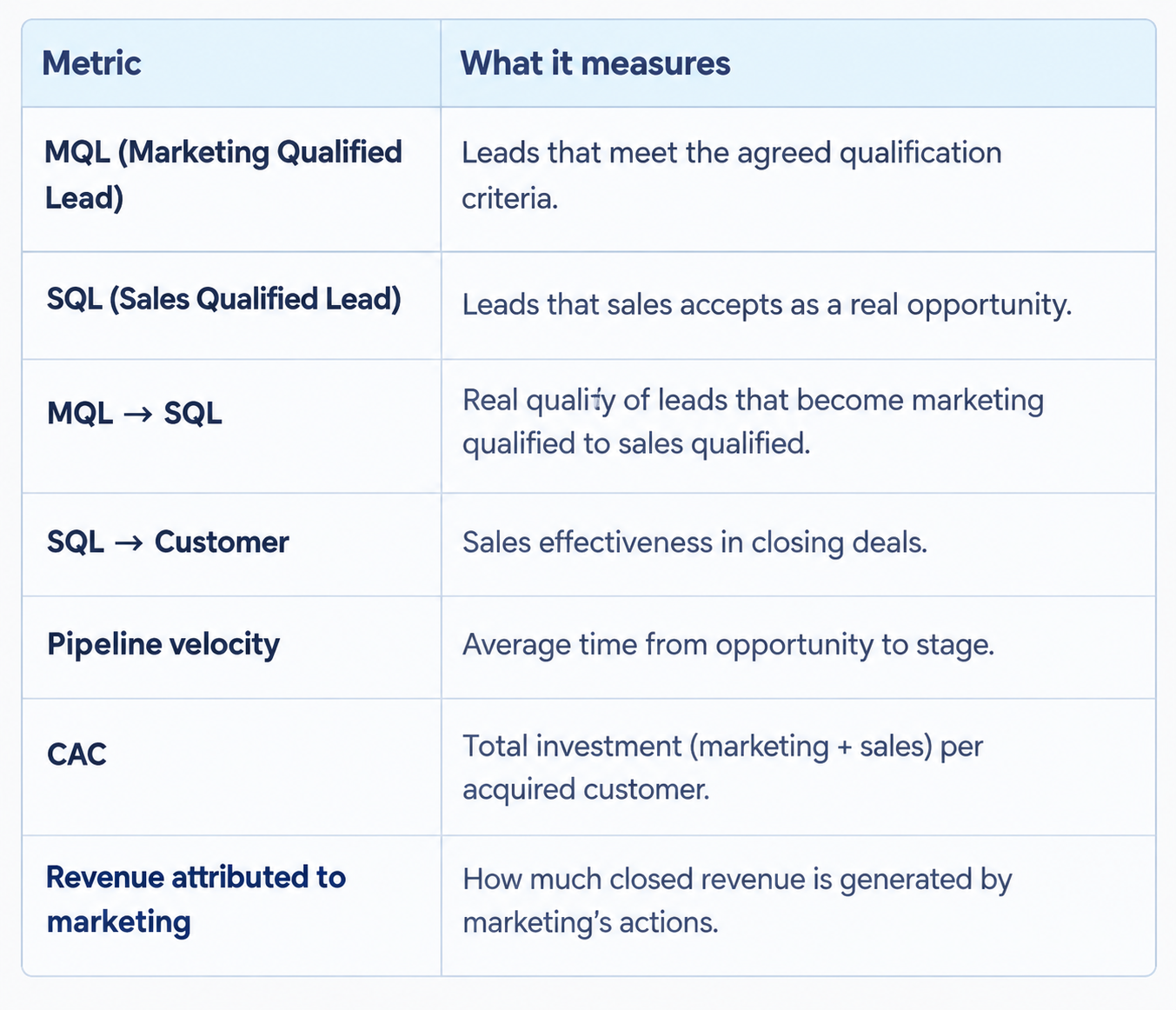
In a functional Smarketing system, both teams share the same dashboard:
The CRM as a single source of truth
You can’t align what isn’t shared. In IT, the minimum requirement for Smarketing to work is for Marketing and Sales to use the same CRM, with data that both teams contribute to and both teams use.
This means Marketing records each lead’s digital behaviour — what content they’ve consumed, which forms they’ve completed and which pages they’ve visited — while Sales records the progress of each opportunity and the reasons why it was closed or disqualified. By combining these data points, the view of the customer lifecycle is no longer fragmented.
Technology can also automate part of the flow: lead scoring based on behaviour, notifications to Sales when a contact reaches the qualification threshold, and alerts when an SQL has gone too long without activity. But automation amplifies a system that already works. If there is no agreement between teams, no tool can replace it.
The communication rhythm that keeps the system working
Processes deteriorate without maintenance. Alignment requires a consistent rhythm:
- Weekly review (30 minutes): active leads, contacts without follow-up and quick adjustments. Not to analyse trends, but to make sure nothing gets stuck without anyone knowing.
- Monthly review (1–2 hours): KPI analysis, lead quality for the month and adjustments to qualification criteria if the data supports them. This is where the SLA is put to the test.
- Quarterly ICP and SLA review: are the agreements still valid? Has the market, product or profile of the customers most likely to close changed? What worked six months ago may not work today.
Do you want your Marketing and Sales teams pulling in the same direction?
At PGR, we work with manufacturers and distributors in the IT sector that need their marketing investment to translate into real pipeline, not just activity metrics.
We help define the SLA between teams, build the ICP using real sales pipeline data, implement lead qualification and handover workflows in the CRM, and establish the KPIs that enable Marketing and Sales to speak the same language. Not as a one-off consultancy project, but as part of the B2B marketing strategy we manage with each client.
If you recognise any of these symptoms in your organisation, we can help you build the system that solves them. Let’s talk.