


.jpg)
You launch a B2B campaign, publish that whitepaper your technical team has spent weeks working on, or share a customer success story on LinkedIn. And then… silence. Impressions go up, but engagement doesn’t. Is your content bad? Probably not. The problem is that your audience is on “autopilot”.
In the IT sector, your potential customers (CIOs, infrastructure managers, developers) are under constant pressure. When they pick up their phones, they often fall into the “scroll fail” doomscrolling trap: they swipe through their feeds looking for relief from mental fatigue, not for your product. They scroll straight past your post without really seeing it.
If your content doesn’t capture attention within seconds, users won’t keep reading
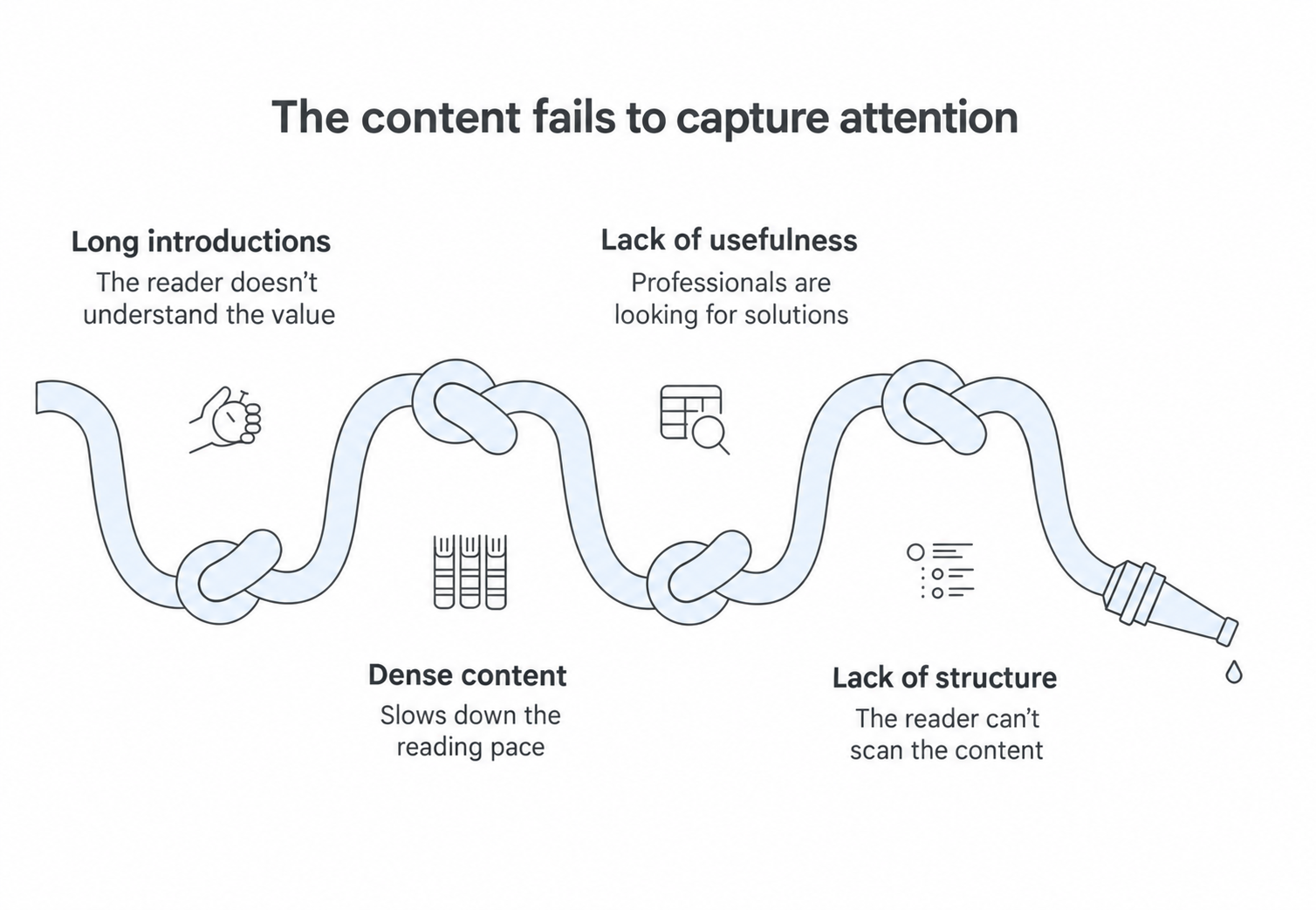
In a saturated digital environment, clarity and value need to be apparent from the very first screen.
So, how do you break that pattern and get people to stop at your post? Here are the key ways to “hack” doomscrolling and win back their attention.
How to avoid “scroll fail”
It’s not about fighting against user behaviour, but about adapting your content to the way people actually consume information.
Here are some key ways to recapture their attention:
1. Design to break through “banner blindness”
The key: Be the splash of colour in a black-and-white world. In the IT sector, a lot of content follows the same visual conventions: corporate blues, technical graphics or stock photos of servers. When everything looks the same, the user’s brain automatically filters it out.
Action: Don’t design simply to decorate; design to disrupt the pattern. Use formats that make people stop and look: visual carousels, videos that grab attention from the very first second, or headlines with large, clear typography. Your content should become a small visual “micro-event” that takes users off autopilot.
2. Give them an immediate purpose (the antidote to “mindless scrolling”)
Doomscrolling happens because users open an app “just to see what’s there”. If your content doesn’t quickly answer the question “why should I read this?”, their finger will keep scrolling.
The key: Avoid lengthy introductions. In B2B, time is the most valuable asset.
Action: Get straight to the problem from the very first line. Avoid lengthy introductions and clearly articulate your customer’s pain point. For example, instead of starting with “We are cybersecurity specialists…”, try a specific question:
“Does your security team spend hours every week reviewing false positives?”
When readers recognise their own problem, they switch from scrolling mode to solution mode.
3. Replace anxiety with usefulness
We know that scrolling is often used as a way to avoid anxiety or boredom. If your content creates even more stress (dense copy, overly complicated language, aggressive selling), your customer’s brain will automatically reject it.
The key: Be the “conscious pause” in their day.
Action: Turn your content into a useful break in their working day. Offer something that provides genuine value: a practical tip, a quick recommendation or an insight that helps solve a common problem. When readers feel that your content is helping them, they stop scrolling and start paying attention.
4. Quality over saturation (the “dopamine fast”)
Publishing constantly doesn’t guarantee more attention. In fact, bombarding your audience with too much content contributes to information fatigue.
The key: Less frequency, greater impact.
Action: Prioritise impact over frequency. Publish when you have something relevant to contribute. The aim is for readers to associate your brand with useful, actionable information whenever it appears on their screen, rather than with more digital noise.
“Scroll fail” is the silent enemy of your conversion rates
Your customers are there, but they’re distracted and tired. To connect with them, you don’t need to shout louder; you need to communicate with greater intelligence and empathy.
At PGR Marketing & Technology, we understand your customers’ pain points and the challenges of the B2B IT sector. We know how to create strategies that don’t just get seen, but get read, stopping the scroll and generating real business opportunities.
Want to stop your message from being invisible? Contact us and we’ll help you stand out.

