



Filling a room isn’t the same as filling your pipeline. Many technology companies invest thousands of euros in events, fill the venue and get plenty of applause… But if, after the event, the sales team doesn’t have valuable conversations, advanced meetings or an activated pipeline, the event ends up being little more than a visibility exercise with limited commercial impact.
The problem isn’t the event itself, but how it is designed before, during and after with a clear commercial purpose.
The event isn’t the goal: it’s the accelerator
In many B2B marketing plans, events are still treated as an objective in themselves: launch the invitation campaign, attract attendees and deliver a great experience. But in reality, the event shouldn’t be the end goal. It should be the accelerator for something much more important: commercial relationships, strategic conversations and business opportunities.
When done properly, an event acts as a turning point within the sales process. It helps open doors, bring strategic accounts closer, strengthen trust and create a much more favourable environment for progressing opportunities that might otherwise require months of interaction through other channels. That’s why the real value lies not only in what happens over those few hours, but in the event’s ability to drive the next step in the customer relationship.
But only if the event is designed to generate business, not just noise.
Best practices for organising an event that generates pipeline
1. Start with the commercial objective, not the logistics
Many technology events are still organised with an approach focused on attendance and visibility. The objective seems to be filling a room, increasing registrations or building brand awareness.
But the problem is that business doesn’t measure attendees. It measures opportunities.
When an event isn’t connected to a broader commercial strategy, it ends up operating as an isolated activity. There is a spike in activity for a few days, but afterwards everything returns to where it started.
Companies that successfully turn events into pipeline tend to work differently. Before they even define the format, they already have much more strategic questions clearly mapped out: which accounts they want to activate, which conversations they need to start, which opportunities they need to accelerate and exactly which profiles should attend the event.
With those answers on the table, the KPIs practically define themselves: meetings booked, percentage of attendees who become opportunities, attributed pipeline and cost per qualified lead. Without this foundation, the event is measured by attendee numbers or satisfaction — metrics that don’t pay the bills.
2. Build an agenda around your customers’ real challenges, not your product
Most attendees don’t go to an event because they want to hear a list of features. They attend because they need to solve specific problems: improve efficiency, optimise resources, activate channels, reduce risks or justify internal decisions.
That’s why events that generate greater commercial impact tend to focus on useful, practical conversations. They talk about the business behind the technology.
When a session addresses real situations, practical use cases or trends that directly affect attendees’ day-to-day work, perceptions change. The brand is no longer positioned simply as a supplier and starts to be seen as a partner with expertise and a strong understanding of the sector.
And that trust is what makes subsequent sales conversations easier.
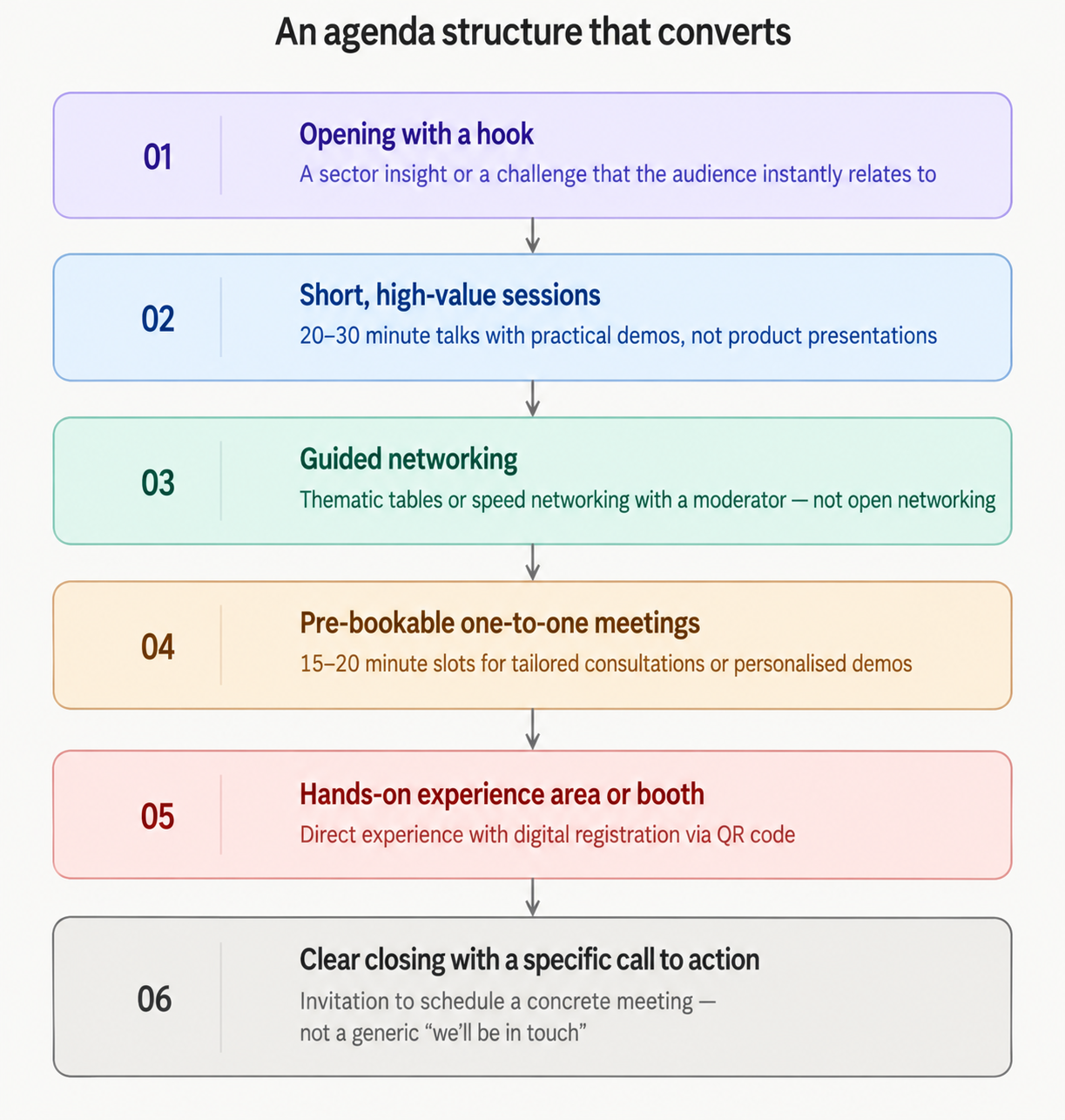
Long corporate presentations are conversion’s worst enemy. Commercial decisions are driven by direct experiences: seeing, trying and comparing things live.
3. Data capture: fewer forms, more useful context
One of the most common mistakes at B2B events is trying to collect too much information from the very first interaction. Long forms, multiple mandatory fields or cumbersome processes create friction and ultimately reduce the quality of the data collected.
At an event, the objective shouldn’t be to accumulate business cards or contacts without context. What really matters is collecting the information needed to understand each attendee’s interests and determine which conversation should continue afterwards.
That’s why the simpler the initial data capture process, the better it tends to work. Name, company, email, job title and primary area of interest are usually enough to start a useful sales conversation. The remaining information can be enriched later using automation tools or integrations with the CRM.
4. CRM integration: interest cools down faster than you might think
Many opportunities are lost in the first few hours after an event. Not because the attendee wasn’t interested, but because the follow-up comes too late or the information doesn’t reach the sales team properly.
Manual processes are still common: leads collected on paper, exports to Excel or databases that aren’t reviewed until days after the event. And in B2B technology environments, where the interest generated during a conversation can be very time-sensitive, that delay often translates into a lost opportunity.
That’s why integration between data capture and the CRM should be virtually immediate. When a lead shows genuine interest during the event, sales needs access to that information straight away, not a week later.
Automating this flow allows every interaction to reach the CRM with enough context to act quickly: which content interested them, which session they attended, what conversation they had or which solution caught their attention. That speed can often make the difference between an active opportunity and a contact who has already lost interest.
5. Lead scoring: prioritise before your sales team wastes time
Not every attendee deserves the same follow-up or should be contacted within the same timeframe. A simple scoring model, applied immediately after the event, allows the sales team to focus on those with the greatest likelihood of conversion.
Here is an indicative example of scoring based on behaviour at the event:
.png?width=1274&height=1235&name=d986e298-bc71-4467-81bf-b524033e4c90%20(1).png)
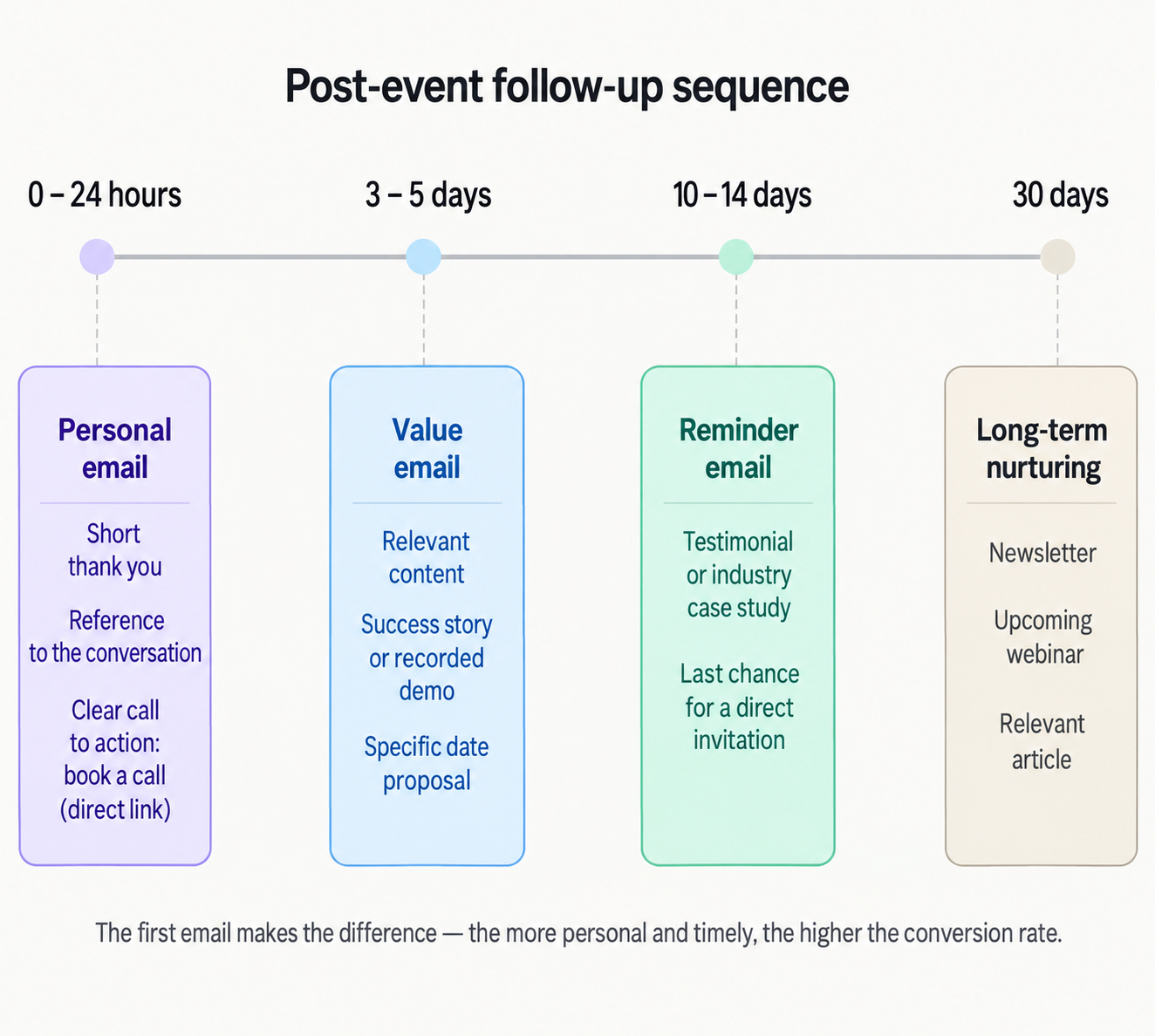
6. Post-event follow-up: speed and personalisation
Speed and follow-up relevance are the factors that most clearly distinguish companies that turn events into pipeline from those that don’t. Sending a generic email three days later is almost the same as not sending one at all.
How PGR approaches events with a pipeline focus
At PGR, we design B2B events for the IT sector with an approach that integrates commercial strategy from the very beginning. That means working closely with the sales team to define objectives, build CRM-connected data capture and follow-up flows, and measure the real impact on pipeline at 30, 60 and 90 days.
Our approach combines event production, content strategy, automation and sales follow-up. We don’t organise events just to make them look good. We organise them to generate conversations that turn into business.
Do you have an event coming up in the next few months and want it to generate real pipeline?
Tell us what you have in mind and we’ll help you design the acquisition and follow-up strategy so that every attendee becomes an opportunity. Talk to our team.

