



Each month, the company reviews how the business is performing: new customers, open opportunities, sales forecasts, revenue...
The numbers may be moving in the right direction and still hide an important question: how many of the customers we acquired months ago are still generating business today?
For a B2B technology company, acquiring new customers is only one part of growth. It is equally important to ensure that those who have already placed their trust in us continue to see value, maintain the relationship and, when a genuine need arises, generate new opportunities.
However, many marketing strategies focus their efforts on what happens before the sale: generating demand, capturing leads, nurturing them and converting them into opportunities.
And what happens after you win the customer?
That is where a second stage of the journey begins, one in which marketing can continue to add value.
The funnel shouldn’t end at conversion
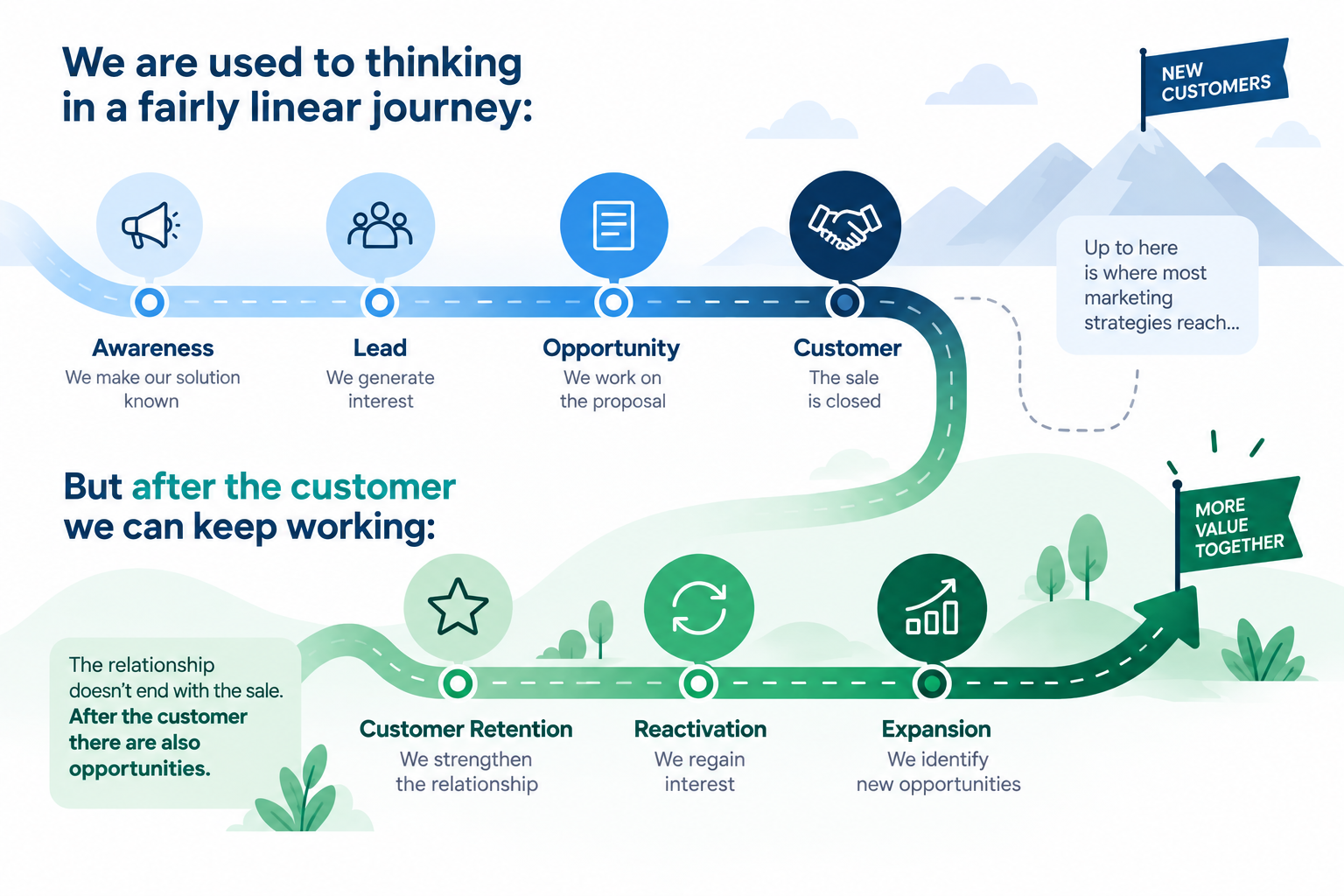
The aim is not for marketing to take over the responsibilities of sales or account management teams. It is about using content, segmentation, automation and data to maintain a relevant relationship with the customers we already have.
For example, a technology vendor can keep an account engaged with content about new use cases. A systems integrator can identify interest in complementary services. A software company can support the adoption of its solution and anticipate a potential loss of interest.
The context may change, but the principle remains the same: the customer shouldn’t disappear from our marketing strategy after the first sale.
Not all your customers need the same communication
When it comes to acquisition, we segment constantly: by industry, company size, role, interest, behaviour or stage of the funnel.
Why stop doing so once someone becomes a customer?
A newly acquired account does not need the same thing as one we have been working with for three years. Nor should we communicate in the same way with a highly active customer as with one we have barely interacted with for months.
At PGR, we can help you use the information available in your CRM and automation platforms to create segments that we can genuinely act on.
A new customer can receive onboarding and support content. An account showing declining engagement can enter a reactivation campaign. A customer interested in a particular topic can receive related resources. And an account showing signs of new needs can become an opportunity for sales.
The difference lies in moving away from communicating because “it’s time to send a campaign” and instead doing so because we have something relevant to say to that customer at that particular moment.
Content also helps build customer loyalty
B2B content is often closely associated with demand generation: articles to attract traffic, guides to capture leads, webinars to identify interest or case studies to help convert opportunities.
But customers continue to have needs after they buy from you.
We can continue to provide value through training content, industry trends, new use cases, specialised webinars or resources related to the products and services they already use.
This means the relationship does not depend solely on commercial interactions.
These interactions can also generate useful information. If a customer starts consuming content about a particular technology, attends a webinar or repeatedly shows interest in a specific area, we may be seeing a signal worth analysing.
It does not automatically mean there is a commercial opportunity. But it does help us better understand what each account is interested in.
From customer loyalty to identifying new opportunities
Working with your existing customer base is not just about preventing an account from being lost. We can also identify upselling and cross-selling opportunities when there is a genuine need.
A customer may start by purchasing a specific solution and, over time, require additional services, expand their capabilities or discover other areas of the company they are not yet familiar with.
Marketing can help shape that journey:
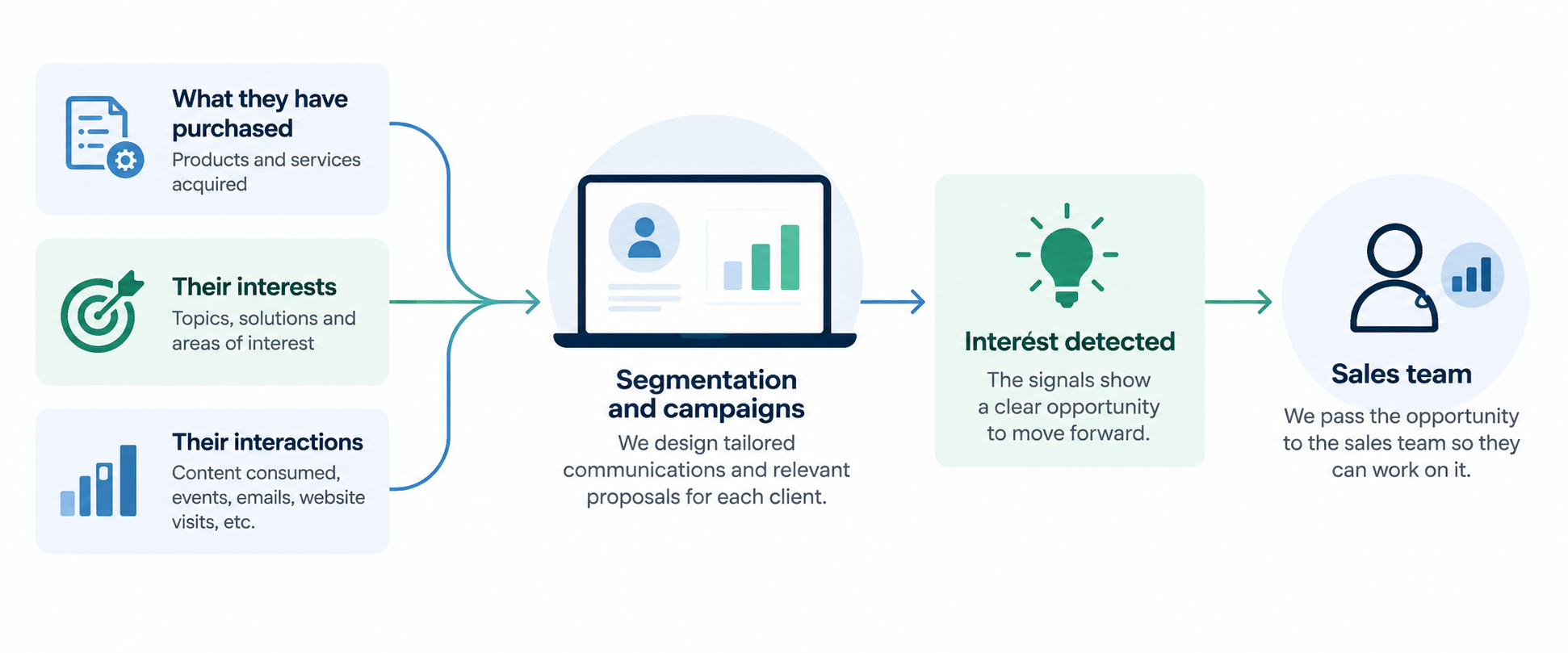
This means marketing does not work solely to acquire new customers. It can also help generate new opportunities within accounts that already know the company.
What can PGR do?
It is not simply about sending more emails to your customers. At PGR, we can help you analyse what happens after the sale and build a strategy around four elements: data and segmentation, automation, content and measurement.
We can define different groups within your customer base, design journeys according to each customer’s stage, automate communications when specific signals occur and develop the content needed to keep the relationship active.
Always with a clear objective: to ensure that every action makes sense within the customer journey and can contribute to building loyalty, reactivating accounts or identifying new opportunities.
Because automation alone does not build a customer relationship. The strategy behind it does.
Growth also lies within the customers you already have
Acquiring new customers will continue to be a fundamental part of B2B marketing. But it should not be the only one.
Within your existing customer base, there may be customers to whom you can continue adding value, accounts that need to be reactivated and companies with new needs that you have not yet identified.
At PGR Marketing & Tecnología, we can help you extend your marketing strategy beyond acquisition, connecting data, content and automation to build customer loyalty and generate new opportunities within the accounts you already have.
Contact us and let’s explore how you can continue generating value after the sale.

